Advent of Code: Day 1
I woke up early and failed to fall asleep again for the first day of Advent of Code. I solved the two puzzles without much problems. The first
part, I did in one try (including compiling correctly) and for the second
part, I needed two tries. I already had some idea that my first try of the
second part was going to fail, but I nevertheless tried it. Then I resorted to
a bit brute force approach for the second part. I also spend some time
improving MarkDownC, the literate programming tool I am using.
At 15:53, I bought the book The Temporal Void
written by Peter F. Hamilton in English, published by Pan Books in 2009,
ISBN:9780330443036, from Het Goed for
€ 2.99 and I bougth a lithograph by
Janny Endstra for €9.99.
Phoenix BIOS
At TkkrLab there was a box with old PCBs,
mostly old motherboards, but also one with 7400-series TTL ICs, donated by someone for everyone who wanted to use
them. On one of PCBs, I saw two ICs with the text Phoenix Technologies Ltd, 1987, 1988. The famous Phoenix BIOS, I presume.
I found a screwdriver to remove them and took them with me.
Advent of Code: Day 3
I have been thinking about the math formulation of this years Advent of Code puzzles just using sets and vectors. For puzzle of today you have to find some sub sequence of 2 and 12 (for the
second part) digits, such when interpretted as a number, the value would be
maximum. This could be described with:
puzzle(V in Vectors of {1, ,, ,9}, l in {1, .. , sizeof(V)})
= max { value in Nat
      | exists v in subvectors(V):
           (length(v) = l) and (value, v) in reverse_base_repensation(10)
      }
In this the V argument is the puzzle input represented as a vector of
numbers from 1 to 9 (including) and l the required length, which is 2
for the first part and 12 for the second part. The function
reverse_base_repensation returns a set with values and vectors
representing that value in the given base where the most significant 'digit'
is at the first location of the vector. (A more logical choice would be to have
the least significant 'digit' first for when you want to define operations on
those vectors.) To make this a bijection (if I am not mistaken), the following
definition can be used:
reverse_base_repensation(n in Nat)
= { (n in Nat, v in Vectors of {0, .., n-1}
  |     n = sum i in {1, .. , size(v)}: v[i] * n ^ (size(v) - i)
    and not v[size(v)] = 0
  }
(One would still need to proof that this indeed a bijection.) A sub sequence or
sub vector is made by taking a specified number of elements from a vector and
arranging these in the same order. So, we need a vector with indices taking
from the size of the vector in increasing order. One can achieve this by
defining a sorting function for the values in a set and an order function.
sorting(S in Sets, order is Sets of Vectors of S) =
= { v is Vectors of S
  |     length(v) = size(S)
    and (forall e in S: exact one i: v[i] == s)
    and (forall i,j: i < j implies (v[i], v[j]) in order))
  }
subvectors(V in Vectors)
= { v
  | forall s subset {1, .. , size(V)}
       exists a in sorting(s, {(a in Nat, b in Nat) | a => b }):
          forall i in {1, .. ,size(v)}: v[i] = V[a[i]]
  }
There are probably other and better ways to define this with mathematics and
with a more mathematical correct notation. (I prefer to use words for
mathematical symbols.) It is not tivial write a program that could execute
these kind of definitions, because it is not immediately clear which is the
correct execution method, let alone to optimize this into a low polynomial
algorithm, because this requires reasoning that goes through all the
definitions.
A free space for experimentation
I went to Rijksmuseum Twenthe to see the
exhibition Enschede: A free space for experimentation. The exhibition offers an
overview of a groundbreaking avant-garde that emerged in the city in the past
hundred years with as highlights the periodical 'De Enschedese School' and
the AKI between 1980 and 2002. 'De Enschedese School' was a periodical of
that was send by mail four to six times per year for a yearly subscription fee,
at first only as printed material but later also other forms of art. It was
started by Frans Oosterhof. I read in
one of the publications (that was folded open under glass) that Wim T. Schippers was also one of the editors. (See for some more
information the page about De Doka van Hercules, a comic book losely based on the Dutch literary
novel De
donkers kamer van Damokles by W.F. Hermans.) However, I agree with
Ernst Bergboer, who wrote (in Dutch): "There was no lie in it, but the significance of art, and
especially the experimental variants that emerged in Enschede, never penetrated
the city". When in 2002 the AKI merged with some other art schools, it became
less experimental and more traditional academic. I am not sure whether that
should be considered as an improvement.
I found the following works from the exhibition noteworthy:
- Model Study, Wim ten Broek, 1951-1952.
- Night with red, Jan Cremer, 1959.
- Garden, Folkert Haanstra (sr.), 1939.
- Untitled, Ben Akkerman, 1960.
- Untitled, Ben Akkerman, 1956-1961.
- Quarrels in the family, Ans Wortel, 1962.
- Untitled, Ben Akkerman, 1953.
- Houseboat in the Twente Canal, Klaas Bernink, circa 1961-1962.
- Interior, Klaas Versteegen, 1986.
- Freedom, Ria Rettich, 1982.
- The Italina Journey from the Brenner Pass to Rome, Uwe Poth, 1946.
- Untitled, Marlies Appel, 1990.
- Style Exercises, Raymond Queneau, 1980. (book.)
- The Painting, Frans Oosterhof, 1980. (Three-colour textile print and linen.)
- Villa Naispier, Jan van de Pavert, 1986. (Book and map.)
- Four oilballs on heavy sirup, De Enschedese School, 1980. (publication.)
- Colorless book, Ernie & Bidet, 1985.
- 650 Years of Enschede, De Enschedese School, 1975. (publication.)
- Post Shanghai, Harry Brusche, 1986. (publication.)
- The Darkroom of Hercules, De Enschede School, 1981. (publication.)
- No.9, De Enschede School, 1982. (publication.)
- Terra cotta me, baby, DE8/Kewi, 1983.
- Sword of Judgement, Kees Maas, 1985.
- The racing car, Gerrit de Wilde, 1984.
- Black Disk, Jan Dietvort, 1986.
- Untitled, Marlene Dumas, 1984.
- Mauhro's Canal, Kees de Groot, 1984. (Video 08'22min.)
I also walked through the rest of the museum and saw (among many other things)
the exhibition Calculating Empires, which I had seen before, and the
following works:
- Nude, Aat Veldhoen, undated.
- Half-nude, Aat Veldhoen, 1964.
- Half-nude (painter's wife), Jan Sluijters, circa 1912.
Sauerkraut
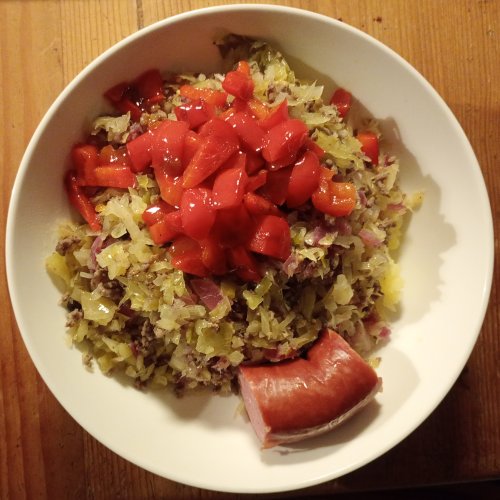
Today we opened our first jar of sauerkraut, which we made with white cabbage.
There are still jars in the meter cupboard with sauerkraut made from red
cabbage and Savoy cabbage. The meter cupboard has a relatively stable
temperature due to the district heating pipes. The potatoes (not visible in
the photo) are also from
Herenboeren Usseler Es. We browned 200 grams of
ground beef with an onion and three cloves of garlic. Then mixed in the
sauerkraut (500g) and left it simmer over low heat. Just before the potatoes
were done, we sautéed a red bell pepper in a little oil and added some
Mrs. H.S. Ball Chutney Hot for a sweet and a bit spicy sauce. We mashed the
potatoes with a generous splash of milk.
Phoenix BIOS (Part 2)
When I was ready to depart from TkkrLab, I
noticed that the box with PCB was still there. I causually made a remark about
having taken the Phoenix BIOS ICs from one of the other motherboards. Then
another member of the hacker space made some remark that he would like to have
them as he took the motherboard, which happens to be from a 286 PC, and already had noted that the BIOS ICs were missing. I have
promised to return them to him.
Enschede 0,7K
In the evening, I paid a short visit to the exhibition Enschede 0,7L at artist collective
B93 with photographs by Cyril Wermers
and collages by Torino.
Advent of Code
At 6:57:25, I finished this year of Advent of
Code. I spend the most time on solving the second part for last
Wednesday. My process of solving the second part is recorded on this mark down page. I am a bit proud that I was able to solve this all on
my own. I read on reddit that many people solving it with the Z3 Theorem Prover. I felt a bit getting trolled for todays puzzle,
because it looked like a very hard puzzle, even for the first part, but it
turned to be rather simple in the end. And the second part was just a bonus
part for it you had solved all previous parts, just like in the past years.
I was a bit afraid that this last puzzle would keep us busy till Christmas.
14.2° Celsius
The temperature at Twente Airport has gone up to
14.2° Celsius, which breaks the previous record of 14.1°C on this date
in 1989.
This evening, I went to TkkrLab and I
gave the two Phoenix BIOS ICs, which I removed two weeks ago,
to member who took the motherboard from which I removed them. He was quite
happy with it and inserted the ICs in the sockets where they came from. He
promised me that if he would find some other BIOS ICs (from a non-working
motherboard), that he would give them to me.
After a lot of debugging the C compiler I am
developing as a replacement for the MES-compiler used in Live-bootstrap, I succeeded in compiling the Tiny C Compiler (TCC) version 0.9.26 resulting in a tcc-boot0
executable. Yesterday, I found a bug in calculating the offset of fields in
anonymous structs and unions. This evening, I wrote the code to fix that
problem. The last bug was related to the fact that the program:
#include <stdio.h>
#include <stdint.h>

int main(int c, char *argv[])
{
    uint_32_t x = 45456;
    uint_32_t a = x >> 32;
    printf("%u\n", a);
}
does print zero but 45456 when compiled with the GNU C compiler to an
executable for an Intel processor. The reason is that the
shr %cl,%eax instruction only looks at the value of the 5 least
significant bits in the cl register, thus interpretting 32 as 0. I
fixed this in my compiler by replacing any right shift expression with a
constant larger than 31 by the constant value 0. After I did this, the produced
tcc-boot0 was the same as the one compiled with the GNU C compiler.
See the 1fcde7aa commit for the final fix. In the coming days, I am going to
write some documentations in the GitHub repository and maybe also do some
additional testing.
Photos and videos
I went to the city where I saw two exhibitions.
At Fotogalerie Objektief, I saw the exhibition Field of Play with
photographs by Klaas Jan van der
Weij. He takes unusual sport photographs. At Concordia, I saw the
exhibition Blue Light District with videos (and one computer 'game').
The works on display are:
- Closeup, Kosti Palhus.
- Mother needs to rest too, Stefania Botezatu.
- The Window, Luchezara Avramova.
- Skating The Soundsystem, Lara Vrgoc.
- Tap to Hate, Yuliia Tarasova.
- Mothballed, Andrea Van Battum.
- Recover, Soyun Lee.
- maria, Antonius Pilars de Pilar.
- eos-9, Berke Telli.
- Sightline 0.1, Yeva Tripoleva.
Amsterdam
I went to Amsterdam. I first visit the Huis Marseille, Museum for Photography, where I saw two exhibitions. I first saw the exhibition Shima no Ama with black/white by Kusukazu Uraguchi who for thirthy years
took pictures of the Japanese diving women known as Ama. Next, I saw the exhibition Rooms We Made Safe with colour photographs by Michella Bredahl. I found the following photograpsh noteworthy:
- My Mother in Her Bed, 1994.
- Self-Portrait, 14 Year Old, 2002.
- Fragment from Bredahl's unfinished manuscript My Heroine.
- My Mother in a Shopping Mall, 1997.
- Family Video, Video 5 min 35 sec, 2024.
- My Dream Hose, 1996.
- Mother as a Dominatrix, 1995.
- Me in My Mother's Bed, 1997.
- Self-Portrait in the Garden, 1981.
- Self-Portrait with my Father, 1981.
- I'm Rescuing Baby Mice, 1975.
- Playing with the Water Hose, 1976.
- Inna (Aerial Silks Paric) in Lyon's Apartment, in Paris, 2024.
- Lyon in Her Room, in Paris, 2024.
- Anna Muraviona and La Baphomette, in Paris, 2024.
- Babycandycars in Her Home, in Paris, 2024.
- Maji Claire, in Paris, 2024.
- Marina Pregnant in Her Bedroom, 2018.
- Anna and Sofia at Home, 2025.
- Siblings Martha, Alma, Olga, Ida and Asta in Their Home, 2023.
- Olga in Her Room, 2023.
- Maria with Her Daughter Cleo at the Georgian National Opera and
Ballet Theater in Tbilisi, 2023.
- Siggy in a Bedroom, 2023.
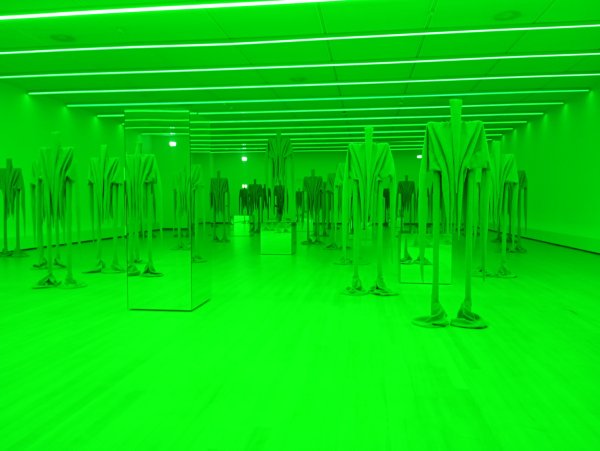
Next I went to the Stedelijk Museum Amsterdam. In first saw the installation Skin to Skin by Sandra Mujinga. Below one of the two pictures I took.
Next I saw the exhibition Things I've Never Seen Before. I found the following works
noteworthy
- How to Act, Gabriël Lester, 1999-2024.
- Editing Space, Gabriël Lester, 2000.
- Piece for Short Movie, Aernout Mik, 1993.
- Fonteintje, Joep van Lieshout, 1990.
- Untitled, Matthew Monahan, 1997.
- In Air I Presume, Jennifer Tee, 2001.
- A Hongkong-Dutch Client Licking My Arm During the Massage
Treatment, Evelyn Taocheng Wang, 2015.
- Untitled, Berend Strick, 1989.
From the exhibition Prix de Rome: Visual Arts 2025, I found the following works
noteworthy:
- Fairy Tale: The Shelf of Life, Brendt Dahl, 2025. (I tore of one
sheet and brought it home.)
- The Shell of Life, Fiona Lutjenhuis, 2025.
- Lusgarde, Kevin Osepa, 2025.
- The Grain that Salted the Sea, Thierry Oussou, 2025.
From the exhibition Blue Dots, I found the following works noteworthy:
- After the Storm, Josef Israëls, 1858.
- Rêve d'amour, Willem Johannes Martens, circa 1892-1895.
- The Levite's Wife, Thérèse Schwartze, 1912.
- Gitanillos, José Maria Rodriguez-Acosta, 1904.
- The Old Gardener, Louis Goudman, 1940.
- Self-Portrait, Theo Molkenboer, 1886.
- The Victim of Misery, Marie de Roode-Heijermans, 1929.
- Portrait of Mr. P. Boendermaker, Jan Sluiters, 1949.
- Concrete houses, Louis Schrikkel, 1927.
From the exhibition Collection, I found the following works noteworthy:
- Cathedra, Barnedt Newman, 1951.
- Newstead Abbey, Frank Stella, 1960.
- Tans West, Kenneth Holland, 1965.
- Karma on Curaçao, Felix de Rooy, 1976.
- Monitor, Robert Ryman, 1978.
- Structure IV, Peter Struycken, 1968.
- Vierkant met sektor, Ad Dekkers, 1968.
- Aggregation: One Thousand Boats Show, Yoyoi Kusama, 1963.
- Art Must Be Beautifull, Artist Must Be Beautiful,
Marina Abramović, 1975-1976.
- Field, Güther Uecker, 1974.
- Footsteps on Mulbery Tree Tops, Ginseppe Penone, 2000.
- Ohne Titel (krebber), Cosina van Bonin, 1990.
- Untitled, Etel Adnan, 2018.
- Visions of the World (Rough and Smooth), Claire Fontaine, 2012.
- Nama Stap, Igshaan Adams, 2023.
- Domesticana Sarawakana (Exotic HouseKeeping), Marcos Kueh, 2022.
- Miss Contamination Cultura (Mother Mary the New Diety, Marcos Kueh, 2022.
- Now You See Me Moria Action Book, Raoul Gottschling & Christian Knöpfel, 2021.
- WireRing, Formafantasma, 2016-2017.
- Colore - Test 7 and Test 3, Formafantasma, 2015-2016.
- LACK #2044 and LACK #10, Sandra Mujinga, 2022.
- Drop Scene (0X5A0936), Paul Mpagi Sepuya, 2018.
- Infe©ted Mondian #2, General Idea, 1994.
- Dentata, Miriam Cahn, 2020.
- No.1, Yang Shaobin, 1997-1998.
- TAPP und TASTKINO, Valie Export, 1968-1969.
I saw the following in-situ art works:
From the exhibition The Best Dutch Book Designs 2024, I found the following books noteworth
(from about half of the books I took a look at):
- Encyclopedia of the Uncertain: a meditation on doubt, Anna Püschel.
- Ondergewerkt, Floor van den Bergh.
- herman de vries, Lynne van Rhijn & Ton Geerts.
- Chin. Ind.
Rest. Stickeralbum, Benjamin Li.
Finally, I saw the exhibition Erwin Olaf - Freedom, which made a big impression on me. I found
the following works (photographs if not specified otherwise):
- Joy, 1985.
- I Wish, I Am, I Will Be, 2009.
- Saskia, aged 8, 1995.
- Julius Ceasar, †44 BC, 2000.
- Nairobi 2, 2014.
- Stoned on Mushrrom Tea III, 1984.
- Portrait of writer Boudewijn Büch, 1983.
- Sturgis, South Dakota, 1990.
- Beauty Pageant, 1984.
- Cum - Self Portrait, 1985.
- Getting Close Again - Self Portrait with Teun, 1985.
- Composition of Two Women, 1985.
- Vrij Nederland 13 mei 1989.
- Powerlifting I, 1985.
- Powerlifting, Erwin Olaf, Rudolf, Jacques, Harrie, 1985.
- Louise & Olav, 1986.
- Double Portrait II Louise and Olav, 1986.
- Marline I, 1986.
- SM in Holland 2, 11, 5, and 12, 1989.
- Ria I, 1987.
- Marie and Child, 1987.
- Chessmen XII, XIX, XXIV, XXII, V, and VI, 1988.
- Bodyparts series, 1992-1993.
- From the Skin Deep series of 2015:
Reclining Nude No.01,
Keyhole 2A,
Chanel,
Male Nude No. 03,
Female Nude No. 02, and
Male Nude No. 1.
- Nederlands Dans Theater 01, 2019.
- After Rodin VI - Cathedral, 2016.
- Two Pieces for HET V, 2022.
- From the Grief series of 2007:
Barbara, Grace, Troy, Caroline, Sarah,
Caroline Portrait, Barbara Portrait, Irene Portrait,
Troy Portrait, Margaret Portrait, and Sarah Portrait.
- From the Paradise in the Club series from 2001:
Dancefloor, Malgosia, Backstage, Matt, and
Renee.
- The Awaking and Troubled Displayed, 2016, Video 4 min 13 sec.
- Anger, 2015.
- Tamed, 2015.
- Köln, Eine Armlänge Abstrand, 2015, wood, burned.
- Auf dem See, 2020.
- Vor der Felswand, Selbst-Portrait, 2020.
- In der Abenddämmerung, 2020.
- Im Nebel, 2020.
- Unter dem Baum, 2020.
- From the April Fool series from 2020:
9:30 am, 11:15 am, 11:30 am, and 10:15 am.
- American Dream, Self-Portrait with Alex I, 2018.
- Shanghai, Moving Self-Portrait, Video, 2017.
- Berlin, Porträt 05.
- Berlin, Porträt 01.
- Olympia Station Self-Portrait 25th April 2012.
- Freimaurer Loge Dahlem - 22nd of April, 2012.
I walked to FOAM. From the exhibition Mid-Air with photographs from Blommers & Schumm, I found the following noteworthy:
- Hidden Objects, Livraison Magazine, 2007.
- Investigation of human interaction in eroticism, Carcy magazine, 2018.
- Shoot at the artist's studio - on the duo's desks, in the kitchen and
on top of a bookshelf, Buffalo Magazine, 2019.
- The class of 1998 (new faces in fashion), Self Service Magazine, 1998.
From the exhibition Atlanta Made Us Famous with photographs by Hajar Benjinda, I found the following noteworthy:
- Barbi Billionz, 2023.
- Barbi Billionz, 2019.
- Money count, 2025.
- Daphnée, 2025.
- Stori, 2023.
- Barbi, 2023.
- Bricks, 2023. (Known as bbuiltbybricks, on soundcloud)
- XTC, 2019.
- Tori, 2025.
- Cleo and her son Andy at home, 2019.
- Ms. Elaine, house mother of Magic City, 2019.
- Niko at home, 2020.
- Barbi and her twins, Hailey and Bailey, at home, 2020.
- Coy, 2018.
- Money Count, 2025.
From the exhibition Witnessing Life with photographs by Co Rentmeester, I found the following noteworthy:
- More than a thousand skaters cross Morra Lake, 1997.
- Almere, 1997.
- A severe winter, 1997.
- Blokweerse windmill, 1997.
- Young male orangutan, 1968.
- Series Veterans Hospital Bronx, New York, 1970.
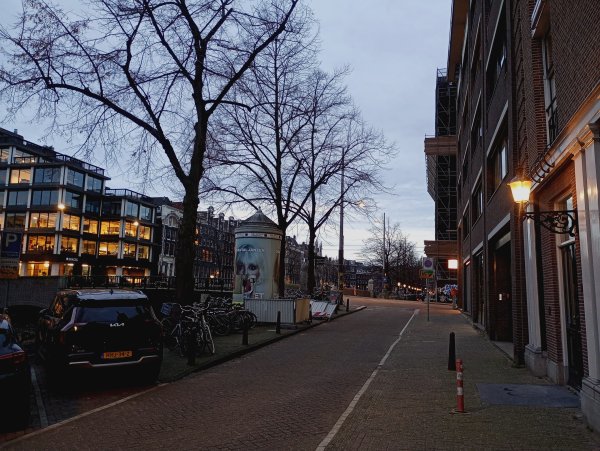
At last, I saw the exhibition You Don't Look Sick by Jasmijn Vermeer. Just outside the museum, I took the following photograph:
On my walk to the Central train station, I visited the bookshops
De Slegte and Scheltema as usual.
Book
At 16:21, I bought the book Mathaf Collection Summary, Part 1 |
مجموعة متحف
فهرس، جزء 1 edited by
ʻAbd Allāh Karrūm, Laura Barlow, Leonore-Namkha Beschi, and Yasser Mongy written in English and Arabic, published by Mathaf publisher
on Saturday, November 1, 2014 from Het Goed for
€ 0.99. The book has two front pages, one for English (where pages
are numbered from left to right) and one for Arabic (where pages are numbered
from right to left). This book is the catalogue of the exhibition with the same title at Mathaf: Arab Museum of Modern Art. I have no idea what makes the art
modern, as it seems not directly related to western modern art, and maybe
modern should be replaced with contemporary. There are some 'geometric' works
that appeal to me, and those are:
Cold Christmas
This night, the temperature at Twente Airport
dropped to -6.5° Celsius, which is not close to the record low of
-13.1° on Christmas 1961 here in Enschede, but still rather cold. In 2021,
the temperature dropped to -6.0° and on 2010 it dropped to -11.4°,
which means it has been fifteen years since we had such a cold Christmas. In
this part of the Netherlands the temperature dropped the lowest. The
prediction for tomorrow is that it will get less cold. There is some chance
for snow on New Years day and it might get colder again.
Even colder
This night, the temperature at Twente Airport
dropped to -7.4° Celsius, which is not close to the record low of
-14.9° on Christmas 1961 here in Enschede, but the last time the
temperature dropped this low was in 1970, more than half a century ago, when it
dropped to 7.7°. Again Enschede was the coldest place in the Netherlands.
Alternative hex0
In the past days, I have been working on producing an alternative for
hex0_x86.hex0. The alternative is hex0.hex0 which is compiled from hex0.c with the C compiler and
toolset I have developed. Although the hex0 that can be compiled from
hex0.hex0 is more than eight times larger than the original and also
not compatible because it proceses less input file correctly, it has the
following advantages:
- hex0 contains debug information such that it can be disassembled
by objdump.
- hex0.hex0 contains direct references to lines of the C program.
- The code in hex0.hex0 is explained with reference to the
Stack_C language, a simple stack based language that acts as an
intermediate representation of the C compiler.
The file is generated with the help of reimplementations of M1 and
hex2 programs that are part of state0 of live-bootstrap.
This afternoon, Conny and I walked through our
quarter for the last time this year. We are not planning to go on a walk
tomorrow, because there probably will be a lot of fireworks during the day,
although it is only allowed after 12, when the new year starts. In the past
months we tried to walk roads and alleys we had not walked before this year (or
even never before). In 2026 we will start afresh and I was thinking about
writing a program to plan all the routes of between 4.1 and 4.4 kilometer
through our quarter, such that with the shortest number of routes, we would
walk through all roads and alleys. If I had to implement this, I would first
draw all the pieces of the routes we would like to walk, than create an
algorithm to find all the routes of the desired length and also have some
properties, such as not crossing itself or containing 'loops', where you
walk around a block and return to the same crossing. The hardest part will
finding the smallest subset of routes that cover all pieces of the routes. It
looks to be a set cover problem, which is known to be NP-complete, but it might be
a subset that is actually not NP-complete. Interesting.
I went to TkkrLab and found that some
member had put some random stuff from cleaning his home on a table. I looked
through it and I took the following items:
This months interesting links
Home
| November 2025
| January 2026