The Mandalorian and Grogu
This afternoon, Conny and I went to see the film The Mandalorian and Grogu. The movie was in the style of the earlier
Mandalorian series. It was a fun watch, but not really memorable. We watched
this in IMAX 2D. I was a little annoyed by the IMAX 'promo' at the start of the
film.
Progress on Task 5
I have complete two sub tasks of Task 5 of the GNU Mes replacement project,
namely the implementation for x86_64/amd64 and for arm64/AArch64. The pass1.kaem script of tcc-0.9.27 step had no
support for the x86_64/amd64 and arm64/AArch64 targets. I had to fix this and
also apply some of the patches for tcc-0.9.26 to get it compiled by the
tcc-0.9.26 compiler. After updating the documentation and optimizing the code
generation of stack_c_arm64.c a bit, I completed these sub tasks.
Next I will have to work on the riscv64 target.
Two more sprouted plants
This afternoon, I cleaned the drain in the alley, because yesterday there was
some flooding in the alley due to some heavy rain showers. After I was done,
I discovered two more new plants in the seed tray that contained the magnolia seeds from last year. I decided to plant them in the garden,
close to where I planted the other plant. These new plants even looked a bit
larger than the first.
Open Studios Enschede
This afternoon, I visited all ten locations of the Open Studios Enschede weekend. I visited the following locations:
- (8) Studio Complex: Where there was not much to do when I arrived.
There was going to be some live band a bit later.
- (9) Creatieve Broedplaatsen Enschede at De Klomp. I talked with:
- (1) B93 & ARE. I talked with the following artists and saw
their studios:
I also briefly saw the exhibition Van de plank which officially only opens tomorrow.
- (2) Black Brick. This used to
be an exhibition space, but now they created some studios upstairs. I
talked with the following people who stayed on the ground floor:
- (5) Minkmaat ateliers. I talked with or saw works by:
- (7) Rozendaal Ateliers. I saw the studios of:
- (3) De 6sprong. I saw the studios of and talked with:
- (10) Creatieve Broedplaatsen Enschede at Tubantiastraat. This is a
new location where there are many affordable studios. I was given a short
tour.
- (4) De Kunsthaven. I talked with:
- (6) Het Robson & St Vierkwart. Because it was almost over, I
walked around a bit, and only talked with Jobke Eijsink. I liked a new work she had on display with dots
and also an updated version of her Postcard stand.
By the end of the afternoon, I felt that my mind could no longer absorb
information. I also realized that I had not visited all the studios that were
supposed to be open according to the brochure.
Exhibitions
I first went to the exhibition Herman Nijhof with photographs by Herman Nijhof, who was a Dutch garden and landscape architect, but better
known in pop music circles as a photographer. I also looked around a bit at
some of the studios of the artists in the building where the exhibitions was
held. I met with an old friend in the city and together we went or B93 where
we went to the opening of the exhibition Van de plank with photographs and works by
Jojanneke Dekens,
Loeske Bult, and
Anja Wisseborn.
Afterwards we also visited the studios of Judith Schepers (from whom I bought a postcard sized reproduction of her charcoal drawing Labyrinth from 2024) and Susan Pinkster.
Weeds and plants
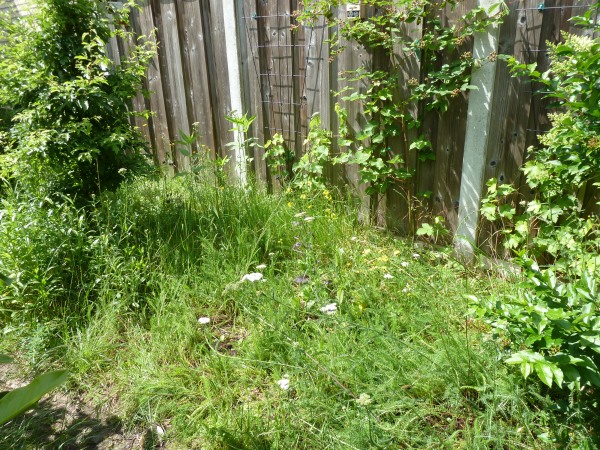
I enjoy the various weeds and plants in our
garden in the back of the house. Below a picture of a part of our garden.
In the left bottom corner the shadow and on leaf of our magnolia can be seen.
Against the fence there are various fruit plants. The tallest is a
rubus. There are also two
grapes. There are also six
mustard greens and
three little magnolia plants among all the weeds. In the back there are three
Jerusalem
artichoke, still rather small.
Faster live-bootstrapping
Harmen Stoppels has developed a
version of live-bootstrapping in the
repository shpack, which
bootstraps a basic, reproducible Linux environment natively from a few hundred
bytes of binary seed to a working GCC 4.7 (C and C++) in 2 minutes and 30
seconds. It makes uses of both the original live-bootstrap project as the tcc_cc compiler that I have
developed and can be found in the MES-replacement repository. It also has replaced the standard library
that comes with the GNU Mes compiler with the musl libc standard library.
Last week I created the boot_cc repository that is a hard fork of the MES-replacement repository
for developments that go beyond the goals of that repository, namely to create
an easy reviewable live-bootstrap solution. After having seen the above
solution, I also looked into performance improvements. I first looked at the
hex2 program, which was taking most of the time during the
bootstrapping. I first implemented a hash tree mapping, based on code I
developed for IParse before. It did give some
improvement. Then I noticed that the time command was showing that a
lot of time was spend on executing system calls. I spend some time reducint the
number of calls by using buffers for input and output. That gave a hugh
performance boost. That probably also proof why the above solution was so much
faster than MES-replacement. Today, I spend time implementing buffered file
input and output in the standard library that is used for the tcc_cc
compiler. It does work well for x86 and x86_64/amd64, but for arm64/AArch64 it
looks like the M1 executable becomes a lot slower. I have not looked
into it yet why this is the case. I nevertheless commited the results.
AKI MUPI route 2026
Yesterday evening, I biked along one of the MUPI advertisement signs to see if
they already had put the photographs with works by the graduates of the
AKI on the back side, because I had not seen
an official announcement yet, only to discover that they had done it. This
morning, I found a facebook post announding the locations of the MUPIs with a link to
a Google map. When I ran my program ParseMUPIkml2.cpp on the downloaded map, it reported two errors. One was
due to one pin being a bit too far from the location of the MUPI and the other
was due to a MUPI that I had not yet included in my map
of possible biking routes between them. After having added the new MUPI and
routes to it, the program returned a route along all the
MUPIs with a length of 35,294 meter. A slightly shorter route, not including my home, of
almost 35Km can be found in Google Maps. I do not know yet, when I am going to bike the route,
because according to the weather and climate plume of today (at midnight) for Twenthe by The Royal Netherlands Meteorological Institute we are in for a heat wave
(according their definition) for almost two weeks including today.
Sign extension in RISC-V instructions
Sign extension is when a signed value represented with a number of bits is
converted to a binary number with more bits, such that negative values stay
negative. For the two's complement method for representing binary numbers, this is done by
assigning higher bits with the value of the highest bit. Hence why it is called
sign extension. I
am studying the RISC-V
instruction set, in particular the RV64I: Base integer instruction set, 64-bit. I am a bit surprised that all
immediate instructions working on 12-bit values (encoded in highest 12-bits of
the instruction) are signed value, meaning sign extension is applied. I
understand the reasoning for doing this for the immediate add instruction,
because it removes the need to also have an immediate substract instruction.
However, I do not understand why it is also used for all bitwise logic operations. This restricts the use of the twelved bit for
logic operations. If you want to do use it, you first have to load an immediate
value in another register before performing the operation. The lui instruction can be used to set the bits 13 to 32 with a
20-bits value, which is also sign extended to fill the highest 32-bits of the
64-bits register. If you want to store a certain value in 32-bits, this means
that you first use the lui instruction and than follow it by a
addi (add immediate) instruction. But you have to take into account
that if the 12-bit is set, it actually means a substraction (due to the sign
extension) of a constant. In that case you also have to increase the value used
in the lui instruction with one to compensate that the sign extension
will result in a substraction of one. If the ori (or immediate) would
not have used sign extension, one could have used that instead of the
addi instruction without having to add one to the value for
lui. It should be the hex2.c program that has to deal with
this, but I have not found the code that does it. The cc_emit.c generates values prefixed with ~ and !,
however, I do not see the corrections in hex2_AArch64.hex1, which I expect to be in the code following
StorePointer_rel3 and StorePointer_rel1.
Biking along MUPIs
From 9:20 to 13:24, I biked around the city to visit all the MUPIs that had a
poster of a work by this year graduates of the
AKI. I mostly followed the route I calculated last
Thursdays. I only made one mistake in the order. At one place I took bit
different but not really longer route. I found the posters of the following
graduate the most interesting:
I found the posters of the following graduates interesting:
I found the posters of the following graduates noteworthy: Eline de Boer,
Tamar den Bok, Manal Al-Harazi, Loes Kingma, Marieta Kritikou, Sofie Reijerman,
Borys Glowacki, Floris Gies, Lea Hadadi, Yordan Kirev, Dahyun Lyu,
Benedetta Zamboni, Irene van Dijke, Dorsheila Malisama, Dilara Tramm,
Emil Ardla, Ece Bakirhan, Havva Malyalizade, and Caroline Schot. It is
difficult to judge the quality of a graduate based on one single image not
knowing the range of works produced and the story behing the image.
I saw the exhibition Milan van Zuilen at
Rijksmuseum Twenthe with works by Milan van Zuilen. I found the following works noteworthy:
- Český les, The Czech Republic, 2026.
- Český les, study, 2025.
- 11 species from my walks, Milíře, 2024.
- Hand in hand, 2026.
- Broken grid, 2026.
- The species from my walk, 2026.
- Second circle, 2025.
- Holding sage, 2025.
- Holding green, 2025.
- Spiraling squares, Hedera helix, 2026.
- Four trees on the Veluwe (video), 2026.
- De Hoge Veluwe, 2026.
- Driftsand, 2026.
- Veluwe, 2025.
- Betula spp. (birch species), 2022.
- Beech and Birch, 2024.
- Steigerwald, Germany, 2025.
- Magnifying glass (video), 2026.
- Fieldwork (video), 2026.
- Museum garden, 2026.
- Betula spp. and friends.
History of the modern literatue
This morning, I finished reading the book
Geschiedenis van de moderne literatuur (Dutch for History of the modern
literatue) by Herman Brusselmans, which I started reading on December 2, 2022 after I
bought it on November 29, 2022. (I have read some
other books in the mean time.) This not an academic non-fiction book one would
expect from the title, but considered by the author himself to be a novel. I
would not so much call it a novel, but rather a mixture of an autographic rant
and a diary. In the first part of the book he critizes Belgian and Dutch
authors often interspersed with accounts of personal encounters with them and
anecdotal stories about them. But increasingly, he writes about his daily
activities, with the occasional bizarre story thrown in. It is rather boring
book, unless you enjoy his kind of humor.
34.1° Celsius
The temperature at Twente Airport has gone up to
34.3° Celsius, which breaks the previous record of 33.1°C on this date
in 2005. We are in the middle of a heat wave (according to Dutch definition)
with the hotest days still ahead (according to the latest predictions). It
started with a maximum temperature of 30.1° on last Thursday. On Friday
the maximum temperature of 33.3° broke an earlier record of 32.6° of
2000 on that day. This was followed by maximum temperatures of 31.1°,
28.7°, 27.6°, and 29.3° in the following days. This means that on
Monday we already had a regional heat wave.
Stoeptegel 1
Around five o'clock in the afternoon, I bought the artwork Stoeptegel 1 from Jobke Eijsink, which consists of two prints each 30 cm square, the size of
regular paving tile. One is a life-size print of a paving tile, and the other
has black dots on a white background, where the dots correspond to certain
features on the tile, resulting in an intriguing pattern that lies somewhere
between totally regular and purely random. I had already seen the work earlier
this month, on the sixth, during the Open Studios day,
and was immediately fascinated by it.
37.6° Celsius
The temperature at Twente Airport has gone up to
37.6° Celsius, which breaks the previous record of 31.3°C on this date
in 1976. Because we knew it was going to be hot today, we left around a quarter
past seven o'clock for a walk. When we crossed the bridge over the
pond called 'Vijver Smuddeboshoek', we saw a kind of rainbow on the water
as shown in the photograph below. It is probably caused by iron-oxidizing bacteria that result in a thin film of iron oxide on the
water.

Sequence A067628
In the past days, I have been looking into the problem of compact shapes of hexagons again. I worked on developing a faster
algorithm to generate more values for the sequence to see if there are maybe
cases where is deviates with more than one with the sequence A216522. This
afternoon, I realized that maybe the sequence for convex shapes on triangular
grid is included in the On-Line Encyclopedia of Integer Sequences. I found the sequence A067628: Minimal perimeter of polyiamond with n triangles. At first it
looked the same, but on further inspection, I discovered that it has many
differences, the first being the 84 triangles, which with the convex
requirement is 26 instead of the 24 in the sequence. The new algorithm starts
with a parallelogram
on the triangular grid, which is defined by the length of the two sides, and
next removes all combinations of triangles on the triangle grid from the two
sharp corners. This also shows that each shape can be defined by four
parameters. If the lengths of the parallelogram are a and b and
the lengths of the sides of the triangles that are removed are c and
d, then the length of the perimeter is: 2a+2b-c-d
and the number of triangles equal to: 2ab-c²-d².
Of course, the values for c and d should both be smaller or
equal to both a and b. This can be achieved by enforcing:
a≤b≤c≤d. I checked that the
algorithm returned the same values as generated with the program convexhexagon.cpp. I calculated values to 10,000 and did not
find any value for which the differences is more than one.
The temperature at Twente Airport has gone up to
34.0° Celsius, which breaks the previous record of 32.2°C on this date
in 1976.
AKI Finals
The AKI Finals already opened last Friday, but I
did not go due to the high temperatures. I heard that many invited people
cancelled and that there was no speech as usual. I went today to see the
exhibition. Below the list of exhibitions from
the graduate that I found noteworthy (based on my very subjective impression)
in the other I encountered them when walking through the building. Some names
are mentioned twice, because I encountered them twice.
At 13:39, I bought the catalogue 25/26 edited by Ruben Steeman and
written in English for € 25.00.
This months interesting links
Home
| May 2026
| July 2026


