Sun Mon Tue Wed Thu Fri Sat
          1   2   3   4   5
  6   7   8   9  10  11  12
 13  14  15  16  17  18  19
 20  21  22  23  24  25  26
 27  28  29  30  31
|
Toki Pona: The language of good
This evening, I got the book Toki Pona: The language of good by Sonja
Lang (formerly Sonja Elen Kisa), ISBN:9780978292300 from bookshop Broekhuis, which I had ordered, and paid € 19.99. In
the evening I read through the book skipping some parts. The book is about
the constructed language Toki Pona, which only has 120 words. The book contains lessons for the
language, but also a kind of hieroglyphs of each word and a sign language.
A few years ago, I made some attempt to learn the language. I think I am going
to try again. The only negative point that I have about the book is that here
and there it contains some reference to the (recently acquired) religious
convictions of the authors, which I find are not appropriate for this kind of
work.
Flowers in magnolia
I noticed some flowers in our magnolia. Many of
them are in new branches. It also needs to be pruned again. It seems it is
growing higher and higher each year. Annabel is feeding branches to her
rabbit, who seem to like it very much. The little magnolia plant now has
nine leaves, but the last three leaves have brown edges and they appear to
be smaller than earlier leaves.
At 17:01:48, I bought the book Speeltuin van de wiskunde: Opties, Kansspelen, Esher,
pi, Fermat en Meer, with editors Bart de Smith and Jaap Top, ISBN:9789076988207,
from bookshop Broekhuis for € 8.95. The
book is about some popular math topics at the M.Sc. level.
Double tree graphs
Some weeks ago, I realized that all possible expansions of the 00 sequence
according to the rules I described on November 23 (of the same length) must have some sequence in common.
What I mean is that if you start with the sequence, choose an expansion
sequence consisting of n successive locations, and applies this
to the sequence 00, resulting in 2n sequences (when
expanding with 1 and 2 at each location), that this collection of sequences
always has a sequence in common with any other expansion sequence.
Yesterday, evening, I thought about the idea, that maybe I could proof
this by studying the properties of the graph you get, when you glue two
tree graphs (represeting each expansion pattern) together and see if it
has some special properties. With some smaller tree graphs, I got the idea
that they always contain a face with three or four vertices and that such
a face could be easily removed. But after some calculations, I concluded
that there was no evidence for such a property. This morning, I decided
to look for the smallest counter example of a combined graph with only
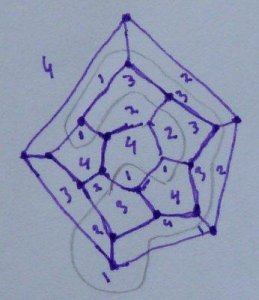
faces with five or more vertices. That is when I made the above drawing
of the dodecahedron graph and drew a line with pencil visiting all faces
once, and thus spliting the graph into two tree graphs. The digits give
(except for some errors) the number of vertices of the face on given side
of the pencil line. The pencil line is actually a Hamiltonian cycle in the dual graph. Next, I realized that maybe
the dual graph of every interesting graph with respect to
the Four colour problem has a Hamiltonian
cycle. According to Tutte,
each 4-connected planar graph has a Hamiltonian cycle. If this is the
case for all interesting (non-reducable) graphs, then it would be
sufficient to proof what I wanted to proof in the first place to proof
the Four colour theorem as well. That would simplify the matter a lot,
except for the fact that it will problably be very difficult to proof
that all expansions (with the same number of expansions) have at least
one sequence in common.
Moleskine notebook
At 20:48, I bought a violet Moleskine Notebook Pocket Plain Hard for €11.95
from bookshop Broekhuis, which I plan
to use as next diary
4-connected
The paper A theorem on planar graphs by William Thomas Tutte, which appeared in Trans. American Math. Soc.
82: pages 99-116, states in Theorem II (on page 115): Let G be any
4-connected planar graph having at least two edges. Then G has a Hamiltonian
circuit. 4-connected means that it is not possible to separate the graph
into two parts by removing 3 or less vertices. The dual graph of interesting
graphs with respect to the Four colour problem
have only faces with three edges and all vertices have degree five or higher,
meaning that they have five or more edges. Because of the triangle faces
(faces with three edges connecting three vertices), every minimal set of
vertices that separates the dual graph must be a cycle. If this is not the
case, it means that there are two vertices on the sequence of vertices that
separate the two components on the plane. These two vertices will be
connected to both vertices on of the two components, and because there are
only triangle faces, it means that there must be an edge between vertices
in the separate components, which would be a contradition. Now suppose that
the dual graph is 3-connected, then the original graph can be split in two
parts that are connected with three edges. It is obvious that this graph
can be reduced. This means that the dual graph of all non-reducable colouring
problems must be at least 4-connected. And from Theorem II it follows that
the dual graph must have a Hamiltonian cycle.
The Jordaan
Today, I got the book De Jordaan: 28000 meter gevelwand (The
Jordaan: 28000 meter facades), ISBN:9789062740079, which I had bought
through the internet for € 15.00. The book is about all of the
facades of the Jordaan
district in Amsterdam. The book was published in 1978 and the drawings
of the facades were made in the five years before. All facades were
measured up to the height of 3 meters and a total of 2,300 photographs
of the facades were taken. The facades were drawn on 72 sheets, 60 x 150
cm, on a scale of 1:200. For the book the drawings were reduced to a
scale of 1:400, each covering two pages. The book is 39.8 cm wide and
26.8 cm high. The book contains introduction in Dutch and English. I
bought this book because it is quite unique.
Another dead-end
Last Wednesday, I found an interesting question on MathOverflow related to
the the Four colour problem by the user
Robert Carlson (maybe Bob Carlson from the University of Colorado). The question
Are all Hamiltonian planar graphs 4 colorable? Does this imply all
planar graphs are colorable? talks about how a Hamiltonian cycle
on the faces of a planar graph, would split that graph in two tree
graphs. It talks about 'diamond switches' and states:
Any tree of size n may converted into another of size n by iterated
diamond switches, DS, of internal branches. I have proven any n-tree
can be converted into any other n-tree in less than 2n DS. Nicely,
if 2 trees are within n DS they have a mutual coloring.
Yesterday, I found the paper The diameter of associahedra by Lionel Pournin of which the abstract starts with: "It is proven
here that the diameter of the d-dimensional associahedron is 2d-4 when
d is greater than 9." The associahedron is related to 'diamond switches' in tree or
flips in polygon triangulations, which are related to
Catalan number.
The OEIS sequence A005152 gives
the first values. This shows that in many cases it is not possible to
convert a tree of size n with n diamond switches (or triangle flips)
and thus not show that they have a mutual coloring.
Triangulation of regular polygons
The number of ways a regular polygon with n-2 sides can be dissected
into triangles (also known as triangulation) is given by the
Catalan number
Cn. Every pair of triangulation for a given regular
polygon has a number of (internal) lines in common. I wrote a program to
count these numbers and the results are given in the table below. The second
column gives the Catalan number for the value given in the first column. The
following columns give the number of pairs that have the number of lines in
common equal to the number given above the column. The total number of pairs
is equal to Cn(Cn-1)/2. The diagonal
sequence 1, 5, 21, 84, 330, and so on, seems to be equal to
OEISsequence A002054.
n    C        0       1       2       3      4      5     6     7
-----------------------------------------------------------------
2    2        1
3    5        5       5
4   14       34      36      21
5   42      273     308     196      84
6  132     2436    2928    1992     960    330
7  429    23391   29898   21555   11220   4455   1287
8 1430   237090  321490  244420  135080  58630  20020  5005
9 4862  2505228 3594756 2872694 1670812 773773 292292 88088 19448
(Addition on November 7, 2015: The numbers in the first column are
OEISsequence A257887.)
This months interesting links
Home
| June 2014
| August 2014
| Random memories


 Tuesday, July 15, 2014