Sun Mon Tue Wed Thu Fri Sat
  1   2   3   4   5   6   7
  8   9  10  11  12  13  14
 15  16  17  18  19  20  21
 22  23  24  25  26  27  28
|
GNU Mes replacement for x86
I am now at the point that I have a replacement for stage0 of live-bootstrap that does not depend on the GNU Mes compiler for the x86 target. On January 27, I had already shown that I had written a C-compiler that could
compile the Tiny C Compiler version 0.9.26. In the past week, I got all other
utilities that are needed to compile the Tiny C Compiler from the source files
copying the structure that is used in live-bootstrap repository. In the future, I might make a clone of that
repository with my alternative for stage0. With this, I have theoretically
completed tasks 2, 3, and 4 of the project. I might still need some additional
testing, fine-tuning, and documenting.
AI building a C compiler
Yesterday, Anthropic
announced that they tasked Opus 4.6 using agent teams to build a C
Compiler in Rust and it in two weeks and burning the equivalent of 20.000 USD in
tokens produced a working compiler. I still believed that AI would not be able
to write complex program such as compilers, but appearingly, I am wrong. I
scanned through the repository, primarily read the documentation, which I
presume was also generated, and discovered that it covers more of C than what
I have implemented in my C compiler for replacing the GNU Mes compiler used in live-bootstrap. I should be noted
that they did use a very large set of unit tests to let the AI generate code for. This is a kind of ideal
situation, because in practice it hardly ever happen that such sets of unit
tests are available when a new piece of software is available. There is a
method called test-driven development (TDD) where you first write unit tests for each
part of functionality you want to implement. So far, I have not really worked
with AI agents, not believing in there usefulness, but now I think I should
maybe look into it more. It will definitely have an impact on software
development in the coming years.
Polygons problems
A few days ago, I came across the article Any-Angle Flow Field Algorithm for Navigation on Reddit, which made me
think about similar algorithms I worked on related to finding the shortest path
between two points in a 2D plane that is limited by polygons on integer points.
It made me also think about the Clipper2 - Polygon Clipping Offsetting & Triangulating library, which
is used in many slicers for 3D printing. (The triangulation function is new to me, but it
does not surprise me at all, because it is very close to the other functions.)
Algorithms to combine polygons (to calculate the union, intersection or
difference) have to calculate the point where two line segments cross. If the
end points of the lines have integer coordinates this does not guarantee that
the intersection also has integer values, because it involves a division and because a division only returns an integer when the numerator
is a multiplicate of the denominator, which is often not the case. One solution
is to 'round' the intersection to the closest point with integer values. This
could change the area of the polygon. So, how to deal with this? One could
define that two polygons are equivalent when they cover the same grid points
(with integer values). With cover we mean, points that are either inside the
polygon or on the polygon. In that case it is possible to construct a
combination of two polygons, but it will probably increase the number of line
segments that are needed. I fear that the algorithms to implement this is far
from trivial to deal with all possible cases. It is easy to define which grid
points should be included into a combination of two polygons, but if the number
is large, it could be difficult to construct a small sets of line segments that
enclose all those points. It is possible that a combination operation results
in disconnected collections of points that require multiple polygons.
Undertow
In the evening, I went to the opening of the
exhibition Undertow with work by Judith Schepers at
artist collective B93. It was an interesting
exhibition. Some of the works are:
- Collection of framed animals bones.
- Drawings on photographs from French from an old book
- Collection of black stones place in a spiral
- The Wanderer And Her Shadow II, 94×128 cm, photo on linen and
embroidery thread, 2026
- Phoenix, photoprint and ink on veil, 2025.
- Old white wall mounted telephone (which I did not recognize as
belonging to the exhibition).
- Analog photo on 20 year old baryta paper and syberian chalk
- Labyrinth, 21×15 cm, ink, chalk, home-cooked charcoal and
watercolor on paper, 2024.
- Untitled, 40×80 cm, photograph and Siberian chalk on birch plywood,
2022.
I took a postcard with a reproduction of Labyrinth, which shows a
labyrinth with a key at the center between the underground roots of two trees
standing close to each ohter, and a small button with the name Cas Klaver.
Loving Art
I went into the city and went to see the exhibition Loving
Art at Creative Broedplaats Enschede. The official opening is this evening at
19:00, but they opened at 14:00. I liked the following works:
- Souvenirs from past lives, Désiré R. De Lacy, 2026.
- All of Your Love (diptych), Henk Holtkamp, 2026.
- Untitled, Anastasia Karsanidi.
- All of My Love, Henk Holtkamp, 2026.
- Sweater with embroidery, Joëlle Lola.
- Untitled, Iulia Paraipan.
- Collage of 14 works, Berta Super Hero.
- Echoes Across the Distance (two self-portaits exchanged between the
artists as a tribute to a friendship), Tom de Groot &
Wahab Saheed.
- Untitled, Dorothea Christiane van Bakel - Hassink
- Consent as a tool for
connection (video and project presentation), The Connection Project
(I overlooked the work by Rosanne de Groot.) I talked a bit with some of the artist presesnt.
2 cm snow
Yesterday, it was already on the news that we would get lots of snow today. During the night the temperature at Twente Airport dropped
to -8.2° Celsius, which is rather cold for this time of the year. Today,
the day started with a clear blue sky and a lot of sunshine causing the
temperature to go up to 4.2° Later in the afternoon, she sky became more
and more clouded. Around 20:00 in the evening, the temperature dropped to
around zero and it started to snow. Around 22:00, I measured about 2 cm of snow
on a surface about the ground. The ground was also covered with snow, but maybe
not that high.
Books
At 16:04, I bought the following two books from Rataplan:
- De Aanschouw written by Edo Dijksterhuis in Dutch and published by
Stichting Met een grote K in 2023, ISBN:9789462625341, for € 2.99.
- Wildsam Field Guides: Los Angeles
edited by Taylor Bruce, illustrations by Caroline Tomlinson, written in
English, and published by Wildsam Field Guides in 2017, ISBN:9781495155390, for € 1.50.
At 16:28, I bought the following two books from Het Goed written by Frida Vogels in Dutch and published by G.A. van Oorschot B.V. for
€ 3.25 together:
I already had seen these two books some weeks ago, but was not sure if I should
buy them, because I do not know whether I will ever find the time to read them.
I have not been reading a lot recently. I also
do not know what is the added value of reading books, except for relaxation or
killing time. I still can not resist the tempation to buy books and extend
my book collection.
RSS feed
Someone asked if I did have RSS feed for my website. I extended my chkhtml.c program to generate an RSS file, the file:
rss.xml, based on the
information available on my home page. The descriptions with the items are
generated from a comment starting with Descr: that are removed when
the file is uploaded. All the items also need to have a GUID. First, I just generated random GUID's using the code found
here. Then I decided to generate it fromt the link. I arrived at the
following statement:
v = 12582917L * v + v % 12289 + ch;
The variable v is a 64-bit unsigned integer and for ch the
next (cyclic) character of the link is used. The value of v is used
for generating the next 'digit' of the GUID until all are generated. You could
also view this as a hash
function. I got the two prime numbers from good hash table primes.
Crocuses
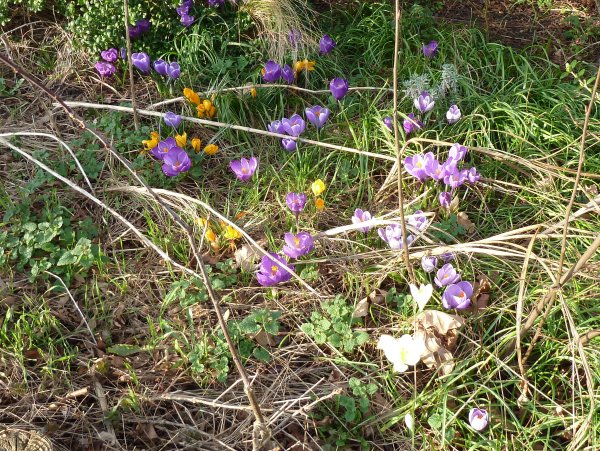
Below a picture of the crocuses in our front garden. They opened in the
past days. Yesterday, there were record temperatures in the
rest of the country. At Twente Airport the temperature went up to 16.7°
Celcius, but that did not break the record from 2019 for this day. Today, the
temperature went up to 17.4°, which does not break the record of 19.3°
from 2019 for this day. It looks like spring has started with temperatures
higher than normal.
Sickhouse Warming (Day 1)
In the afternoon, I went to the opening of Sickhouse at their new location. They have organized the Overkill Festivals. Last year, there was no Overkill festival, because
they had to evacuate the old location and were still refurbishing the new
location, which we opened with a small festival today and tomorrow. Because I
went into the city, I first went to see the exhibition FIA (Fine Art Intelligence) at photo gallery Objektief.
At Sickhouse, I attended the afternoon panel talks.
Feminist media, Feminist practice
The first panel talk, the panel members first gave an introduction.
Christie Morgran
talked about Softer, a movement for
softer digital futures. It is based in both Copenhagen and London. They also
plan on having an event in Amsterdam, possibly with Valerie Fuchs. They had an online event with Mindy Sue along side the Soft Robot event that was held last week. Next Vanity Roxane talked about The Fem Dem that she started to empowering woman. She mentioned
Open Source Radio, where they curate
music, and Nieuwe Electronische Waar, as some of the things she was/is involved with.
As the last panel member, Juliette Lizotte
introduced herself. She is involved with Hackers & Designers in Amsterdam. She talked about two projects:
Sisters of the Wind and Harri Kanta, which was shown on
Overkill 2024. During the panel discussion,
Christie remarked that she noted that technical tutorials, such as for example.
for 3D modeling, are ofthe hyper masculine.
ALT-Tech for Alternative Futures
Roos Groothuizen calls herself a media artist
who cares about human rights. She talked about a DIY alternative for digital doorbells that upload footage to servers and
are used for surveillance. See instructions in English for building one. Pablo San Gregorio is a game designer, who has one of his creations in the
exhibition, and an aspiring artefact artision. He wants to know how things do
work and how they are made. Sunjoo Lee
talked about her Electric
Garden project that involves microbial fuel cells and one of the projects she did at Creative Coding Utrecht. Rein van de
Woerd talked about permacomputing and about self hosted websites.
Finding, Building, Claiming our Space
In this panel Tessa Wiegenrinck
(photographer), Alicia Breton Ferrer, (from Roodkapje
Rotterdam), Marie Janin (from Sickhouse), and Jasper Schütz and Reinier (both from Studio Complex Enschede were asked questions about their art spaces.
Exhibition
In the exhibition at Sickhouse the following artworks, installations, and/or
games were present:
- Drift, a sound and light interactive installation by Maggie Khorrami.
- I remember… Ongoing stories and memories of Sickhouse's
community, a video installation. Collective archive by Sam & Tessa.
- Mega
Dreoilín, walkthrough video installation
by Han Hogan and Donal Fullam. An art project in the form of a 16-bit
video game about the challenges to be young and find a house in Dublin in
the middle of the housing crises.
- RoBowGotchi, an Art-cade Machine by Vincent Schoutsen, Wouter van Veldhoven, Leon
Denise & Emilie
Breslavetz.
- Alternative ways of inhabiting space, an interactive Installation by
Paulina Martinez.
- Various photo presentations by Tessa Wiegenrinck.
- Loopscroll game by Pablo San Gregorio.
- Crockpot game by Emily
Kroonce & Blake
Andrews.
- Bubble Rage game.
- Border game.
- Somnia game.
I also saw the book Deep Simulator Ag in the 'library'.
Drift performance
Around 20:00, I watched the performance of Maggie Khorrami with her installation Drift, a sound and light
interactive installation. During the performance she controlled the music with
“RAGΞN", a
wearable instrument — a body extension built with Conductive Rubber Cord
Stretch Sensors that translates movement into sound. Interesting.
Sickhouse Warming (Day 2)
Today, I attended the second day of Sickhouse Warming. I primarily went there
to watch movies and documentaries. I saw:
- At 12:30, the movie Flow by Gints Zilbalodis. I was afraid that I would got bored during this
movie, but it was quite entertaining.
- At 15:30, the documentary Hotel Mokum, which is about a group of people squatting a former hotel
in Amsterdam and being evacuated.
- The documentary This is TMI.
Quite funny and entertaining.
- The documentary Happiness by
Firat Yücel about an activist who struggles with insomnia due to
being able to stop following news from Palestine and across the region.
(I struggled abit with keeping my eyes open, not because it was boring.)
- At 17:30, the documentary Still playing by Mohamed Mesbah about the game developer Rasheed Abueideh who created the game Liyla & The Shadows of War and is now working on Dreams on a Pillow.
- Into the evening, the randomly selected cult movie Bad Taste, the first movie made by Peter Jackson.
I left the premises twice in between the screenings: One time to visit two
bookshops in the city center and one time to go home for dinner.
This months interesting links
Home
| January 2026
| March 2026


