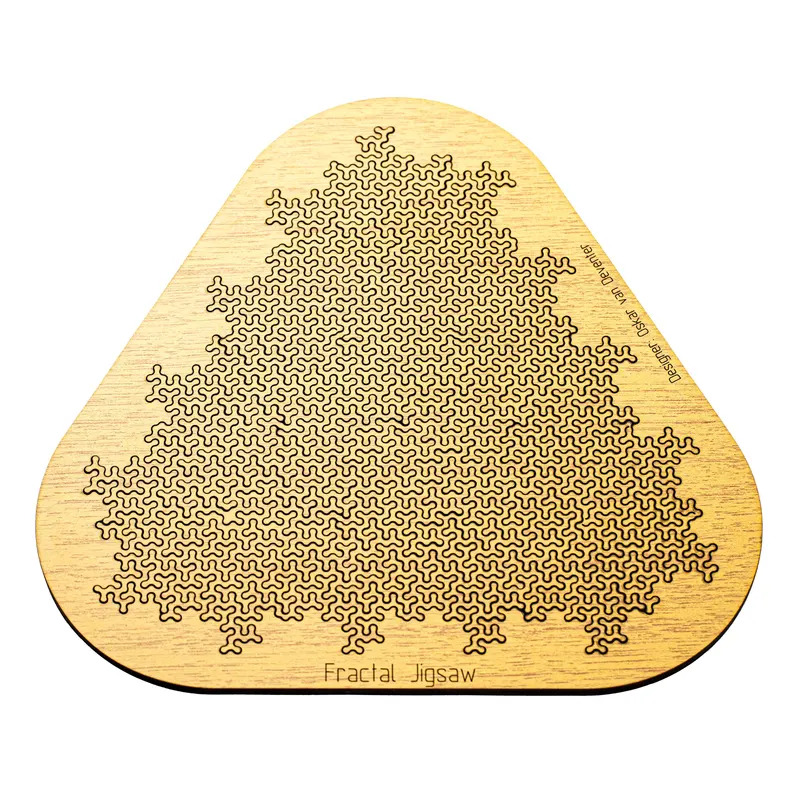
The above puzzle is designed by Oskar van Deventer. He has a YouTube video showing it. This video was the inspiration for my research
into this type of fractal puzzles. The puzzle can be bought from him from
Etsy.
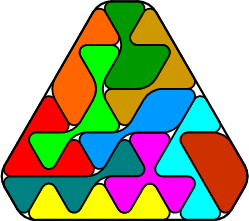
The first image visualises the pieces that make up the puzzle. (There is a link
to this image on the page Material added 25 Dec 05 under the heading 'Bridged DiTans and Triamonds'
on the mathpuzzle website.) The second image explains how each piece consist of
a number of connected triangles. (The image is taken from the section 'Bridged Polyamonds' from the Logelium website.) In most of
the pieces the triangles are connected on the corners, but there are also some
where some triangles are touching on the sides. The red brown piece in the
right bottom corner consists of three triangles that all are connected on
sides. When I saw this, I wondered whether it would be possible to create a
puzzle with pieces where the triangles are only connected on the corners. So,
that made me think about developing a program for generating this kind of
fractal puzzles.
L-system fractal
Arcs of one third circle
G1 = lr
G2 = lr l lr r lr
Gn = Gn-1lGn-1rGn-1
Triangle: GnlGnlGnl
Space filling curve
Giuseppe Peano
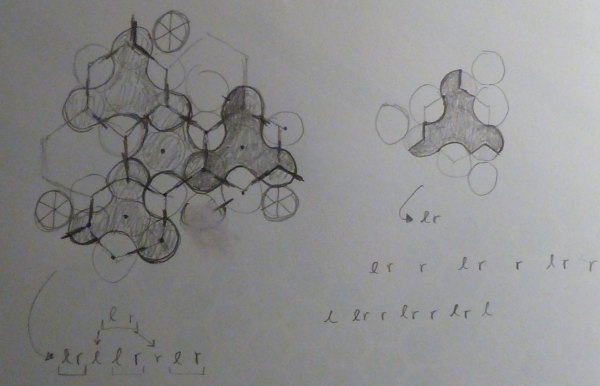
The first step was figuring out how the fractal shapes were generated. I
started make some drawings and figured out that it is based on an L-system or Lindenmayer system and its production rules. In the above
animation it shows the various generations of the fractal where three copies
(in the colours red, green, and blue) are used to create a triangle shape with
three grey connecting bends. Each bend is a third of a whole circle, an arc of
120°. There are two types of arc, that we call l and r,
refering to whether the arc makes a left or right turn. (Due to my dislexy, I
often swap left and right.) The simplest fractal pattern can be described with
'lr'. For the next it is
'lr l lr r lr'. The general rule is to take
three copies of the previous generation and separate them by an extra l
and an extra r.
The curve is also a space filling curve. Because Giuseppe Peano was the first to discover one, space-filling curves in the
2-dimensional plane are sometimes called Peano curves, but that phrase also
refers to the Peano
curve, the specific example of a space-filling curve found by Peano.
Triangles and connection points
33 triangles
19 connections points
Piece has triangles and connection points
For a solution:
Pieces cannot overlap
Each triangle covered
Exact Cover
Donald A. Knuth: Algorithm X
Dancing links
Above the abstract representation of the puzzle to be solved. For a correct
solution, pieces cannot overlap. This means that every triangle and connection
point cannot be covered by more than one piece. Furthermore, each triangle
needs to be covered. A piece consist of a number of triangles and connection
points where the triangles are connected. In general it will not have more
connection points than triangles. This problem looks very similar to
exact cover.
Donald A. Knuth used
the Dancing links
technique in his Algorithm X to solve exact cover problems.
Designing a puzzle
Perimeter
Size of the pieces
Variation of pieces in solution
Number copies of a type of piece
Multiple solutions
Difficulty
When designing a puzzle, there are a number of properties to be considered.
The first is the shape of the perimeter within in which the piece need to be
placed. The second is the size of the pieces, the number of triangles that are
used. The third is the variation of pieces in the solution: many small or
also some large pieces. The fourth is the number of copies of the same type of
piece. Often, solutions will contain multiple copies of the smaller pieces.
The fifth is the number of solutions. It might be the case that for a certain
set of pieces there can be more than one solution. Do we want a puzzle with
exact one solution or do we allow multiple solutions. The last, is the
difficulty of the puzzle. It is not necessary that a puzzle with one solution
is harder than a puzzle with multiple solutions.
Size of the pieces
Generate Exact Cover with hard-code pieces set:
./pianofrac gen_ec_hc -with_name
Generate Exact Cover with specified piece sizes:
./pianofrac gen_ec -con -range=2-4 -with_name
The pianofrac program (to be found at my FractalJigsawPuzzle repository at GitHub) can generate and Exact Cover
problem with the command gen_ec_hc for the hard-code set of pieces or
the gen_ec command with pieces of a certain size, specified with the
-range option. (The options -con and -with_name are
required for the following steps.)
In the above command the ExactCover program is used to solve the
Exact Cover problem to generate all possible solutions. Due to the rotation
symmetry of the puzzle, there could be three duplicates of a solution. To
filter out these duplicates the normalize command of the
pianofrac program.
The used_pieces command of the pianofrac program, sums the
names (numbers) of the pieces that are used in each solution listed in the
input file on a separate line in the output. With the help of the Unix programs
sort and uniq a list of puzzles, sorted by the number of
solutions, can be created. This still results in a large file of puzzles,
which could make selecting a puzzle hard.
Filtering
Filter on number of pieces per puzzle:
./pianofrac used_pieces -min=14 -max=16 <sols.txt
Filter on number of duplicates per type of piece:
./pianofrac used_pieces -max_occ=4 <sols.txt
Filter on number of maximum number of duplicates:
./pianofrac used_pieces -sup_occ=9 <sols.txt
The used_pieces has some options to filter out puzzles on a number of
conditions. With the options -min and -max one can restrict
the number of pieces to be used in a puzzle (the specified values are
included). With the option -max_occ it is possible to restrict the
number of duplicates per type of piece and with -sup_occ it is
possible to restrict to total number of duplicates for all types of pieces.
In case no puzzles are returned the program prints out the 'minimal' limits.
With the filter command of the program, the solutions with a puzzle
can be selected from the sols.txt. The 'name' of the puzzle is
sequence of the numbers found in the puzzles.txt file (without the
number specifying the number of solutions for the puzzle).
The the svg command an SVG file can be generated. The -space
option can be used to specify the space between the pieces. If the option is
not used, there will be just a single line between the pieces. For more
options see the FractalJigsawPuzzle repository on GitHub.
Puzzles
First puzzle with a single line
Double line experiment
Collaboration with my daughter:
10 puzzles with 29 pieces
Select the pieces
Each puzzle uses a unique piece
Different number of solutions
Different level of difficulty
Larger puzzles
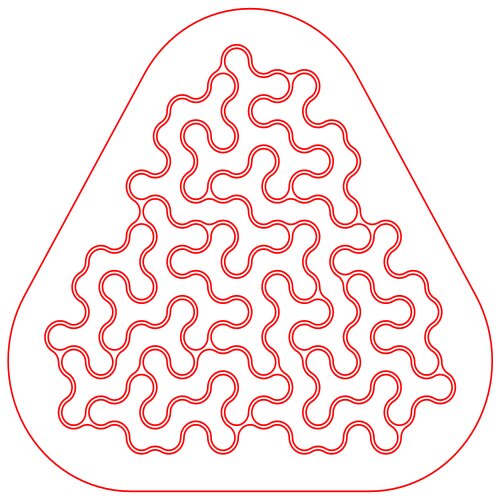
The first puzzle was made with a single line and with G5 puzzle. It
was quite difficult to get the pieces out of the puzzle. And because the
aspect ratio was not exactly 1, putting a symmetric piece in the wrong way,
will make it very hard to get it out again. Not really playable. We drilled a
hole into the side such that it can be hung on the wall.
Some of the mentioned puzzles can be bought from the website
annabelester.
Number solutions versus difficulty
Are puzzles with but one solution more difficult?
How to measure difficulty of the puzzle?
Average number of tries using optimal strategy
graph:
left-to-right: difficulty
top-to-down: Number solutions
Table 'equal' distribution in ten sets
Not a very strong correlation
Few puzzles with many solutions that are very difficult