Saturday, May 11, 2024
Harvest
Today we were able to pick up the first new harvest of this year at Herenboeren Usseler Es and we ate some of it yesterday. Below is a photo of the harvest. At the front are the herbs (from left to right): dill, plantain, parsley and coriander. Behind this are the vegetables (clockwise, starting at the bottom left): arugula, spinach, head of lettuce (own variety), flowering bok choy and another head of lettuce.

Aurora borealis
Last night I went outside several times to look in our backyard to see if I could see any of the aurora borealis caused by the solar storms. There was some light polution due to some cloud cover. I was not in the mood to bike to a darker spot about 5 minutes away, afraid that it would be for nothing. I did noticed some pink glow and went to get my camera and a tripot, but it the glow seemed gone when I took some pictures. Today, I downloaded the pictures, which turned out very dark. I fiddled a bit with the brightness and the constrast, resulting in the image shown below, which does clearly show a pink glow. Others have made much beter pictures, also from my neighborhood, which I saw on social media.

Link
Monday, May 6, 2024
Hytti nro 6
Yesterday evening (and early this night), we watched the film Hytti nro 6 (in English called Compartment No.6) from 2021 on TV, in which a Finnish girl called Laura travels from Moscow to Murmansk because she wants to see the petroglyps at some islands on Lake Kanozero. Most of them are located on the Kamenny island. When she arrives in Murmansk she hears that in the winter it is not possible to see the petroglyps, but with the help of some people she finally succeeds to visit the island (but it is not clear if she found the petroglyps). According to Google Maps it is about 5 hour drive to get to the lake. If she would had get out of the train at Apatity it would have been a little more than 2 hour drive. The film is loosly based on a novel with the same title from 2011 with the same title by Rosa Liksom.Arabic Typography
I have started reading the book Arabic Typography: History and Practice with Titus Nemeth as editor and author. On page 8 in footnote 18 it says: 'A related observation can be made for the exchange on theoretical matters between Donald Knuth and Douglas Hofstadter in Visible Language (XVI, 4, 1982), which appears to take place in an idealized context with a single writting system, and - especially from Knuth's point of view - little acknowledgement of the cultural load of letterforms.' This seems to refer to articles The Concept of a Meta-Font by Donald Knuth and Metafont, Metamathematics, and Metaphysics: Comments on Donald Knuth's Article “The Concept of a Meta-Font” by Douglas Hofstadter. Metafont played in important role in the early history of computer fonts. The first fonts used in computers where bitmaps. The first vector based fonts were developed before Metafont in 1974. Metafont came around the same time as the development of PostScript, which started around 1976 and released to the market in 1984, and PostScript fonts. which later lead to the development of other vector based font systems such as OpenType and TrueType.On page 12, it mentions that at the start of the seventeen century, the center of Arabic printing and Arabic studies moved from Italy to the Netherlands and that Thomas Erpenius played an important role. He published the book Grammatica Arabica written in Latin, which presents a grammar for Arabic. The grammar starts on page 203 (of a total of 846 pages) with the chapter Orthographia. In the following pages, I often see the use of kashida. It seems it is not always used for justification, but also to make it easier to identify the separate letters beter for readers not very familiar with the script.
GNU Mes in emulator
It looks like there might be something wrong with the execution of GNU Mes in the i386 emulator. The execution of the following command (step 227) seems to work:./bin/mes-m2 -c "(display 'Hello,M2-mes!) (newline)"And also the command (step 232):
/usr/bin/mes-m2 -L module gen-cpp-files.scmRuns to completion and produces the files: cpp-act.scm and cpp-tab.scm in the directory /steps/mes-0.26/build/nyacc-1.00.2/module/nyacc/lang/c99/mach.d/. But then the execution of the command:
/usr/bin/mes-m2 -L module gen-c99-files.scmSeems to get stuck or at least take many hours to complete. I noticed that there might be something wrong with the implemenation of the ioctl system call. I fixed that problem and started the program again. I still is taking a long time to complete the given step.
Debugging an emulator that is running an interpreter is going to be very complicated. I am considering the option to compare my implementation with some other emulators. One example being the x86 emulation library. Or study the QEMU sources in the target/i386/hvf directory.
Sunday, May 5, 2024
GNU Mes
In the past week, I have been working on getting the i386 Eumlator to execute the GNU Mes compiler. For that I only had to implement some additional instructions and also a number of system calls, some of which I wonder why they are needed. The Mes compiler executes rather slow in the emulator. One reaons is that it uses a Scheme interpreter to implement the compiler. So, it is running an interpreter within an interpreter (because the emulator is basically an interpreter executing machine code). It looks like the parse is table written. If so, this can be seen as another interpreter. The GNU Mes is an odd one out in the whole chain, because it is implemented in a subset of C, implementing a C compiler to compile (several versions of) the Tiny C Compiler, which again is used to compiler a version of the GNU C compiler. Why bridge the 'gap' between the subset of C compiler and what is needed to compile the Tiny C Compiler. It seems to me that the gap is not that big, also because (I expect) that not all C is used in the implementation of Tiny C compiler.Books
This afternoon, I again visited the book fair in Glanerbrug. It was the last day and they had a 50% discount. I primarily searched the art book shelves. At about 13:08, I bought the following books:- Coda Paper Art 2017 written by Eva Schaap, written in Dutch and English, published by CODA Museum in 2017 for € 1.50.
- De Nederlandse identiteit in de kunst na 1945 edited by Geurt Imanse in Dutch and published by Uitgeverij Uniepers in 1984, ISBN:9789029015493, for € 1.00. (At how, I discovered that I already own the 1995 reprint of this book.)
- Rietveld Schröder Huis written by Bertus Mulder,Ida van Zijl in Dutch and published by V+K in 1997, ISBN:9789066117419, for € 0.50.
- Driedimensionale Typografie | Threedimensional Typography written by Joseph Semah written in Dutch, English, and (some) German, and published by Stichting Makkom in 1994, ISBN:9789068370225, for € 1.25.
- Kunst en vormgeving bij de PTT edited by Lily van Ginneken, written in Dutch, published by Openbaar Kunstbezit in 1985, for € 0.50.
After this I bike to the Maker Festival organized by TETEM art space. Inside TETEM, I watched the Narcissus art work and the self-build plotter by Roland Blok. The plotter is used for Single Line Selfie, which makes use of software he developed himself. I also watched the exhibition Kindness Practice by Handi Kim. Outside, I saw the Linuparus meridionalis animaltonics build by Tristan Kruithof and heard the 'Robot Max', a drum robot, by Ponytrap. I met someone who I knew whoe remarked that the age category of the goal audience is getting lower and lower each year. I could not deny his statement.
I went to bookshop Broekhuis and at 14:38:14, I bought the following three books for € 10.00 from the outside sale:
- Foto Biennale Enschede 1986 edited by Lisette Pelsers, written in Dutch, German, and English and published by Stichting Foto Biennale Enschede in 1986
- The Heart of the Matter: Tobias Schalken ; Selected Works written by Tobias Schalken written in English and published by d'Jonge Hond in 2010, ISBN:9789089102089,
- Het leukste jaar uit de geschiedenis van de mensheid: dagboek 2001 written by Ronald Edgar Giphart in Dutch and published by De Arbeiderspers in 2002, ISBN:9789029522298
Saturday, May 4, 2024
Links
Friday, May 3, 2024
Exhibitions at University of Twnete
When I studied at University of Twente (then still called Technische Hogeschool Twente), I once saw an artwork in the Vrijfhof-building that consisted of a number of books where on every page that were stamped but a single letter. If I recall correctly the letters formed the text of the Dutch translation of Ecclesiastes. I have tried before to find out who made this art work. There is no mention of it in my diaries. (In that time, I used not to write about what I did or saw.) Yesterday, I spend some time to go through all the university newspapers of the periode 1982 till 1986 to find out of I could find something more. Today, I spend some time to find links for these exhibitions. I get the idea that not all exhbitions are mentioned in the unversity newspaper. I do remember having seen several exhibitions with wooden mechanical devices including music instruments. Below the list of exhibitions I found.- 1982:
- January 23 - February 22: Lucyna Prasil
- February 27 - March 28: Photographs by Werner Rauwerdink, Julius Visser, Johan Ghijsels.
- March 1-15: Bart Gieskes.
- June 12 - July 12: Christina Ziach
- September 24 - October 18: Kunstenaar op reis/Reizen als kunst.
- October 23 - November 22: Karel Becker.
- (Around November 11): Exhibition by AFVD.
- November 27 - December 20: Igot Hudcoviv.
- 1983:
- January 15 - February 14: Afronding with works by Gustave Nouel.
- February 14 - March 19: Bruno Ninaber in BB-bulding.
- February 19 - March 21: Aquarels by Riet van den Beldde Caluwe.
- March 26 - April 18: Gouaches by Rosamarie Gerritse.
- April 11 - 18: Honhoftuin by Geert Nijboer.
- - April 29: Jeroen Henneman.
- - May 21: Exposition by Foton.
- September 21 - October 17: Photographs by Julius Visser, Herman van Ommen, Johan Ghijsels.
- October 22 - November 21: New York reflections with photographs by Michiel Czn. Dhont.
- November 7 - 18: Rinus Roelofs.
- - November 11: Lithos by Jo Pessink in BB-building.
- November 26 - December 19: José Koebrugge.
- - December 19: Foton exhibition.
- - December 23: Margreet Zwetsloot and Nettie Franken in BB-building
- 1984:
- - February 27: Annie van Stuivenberg.
- February 13 - March 9: Nic Blans jr. in BB-building
- March 3 - April 1: Barbra Schmidgall.
- - April 17: Painting by Kees Mettes.
- April 7 - May 7: Beata Wojda.
- - May 7: Photographs by Mimi and Henk Kamphuis
- - April 27: Joep Goeting in BB-building.
- May 12-28: Ellis Platter.
- May 12 - June 12: Chris Jonker-Wilkens and Minke Kleima-Roorda.
- June 2-17: Photographs by Arthur van Ligten.
- First two weeks of September: First photo bienale: Bill Burke, Cor Jarin, Kees Tabak in BB-building. Wilfred Evers, Phillip Galgiani, and Wendy Watriss and Frederick Baldwin in Vrijhof.
- September 24 - October 19: Erica van Jeveren-Booij and Stella Jansen-Tuma in BB-building.
- September 26-28: Videoase Video-festival.
- Esculture by Bert Schutter. (Interview in Dutch)
- image process installation by Ferdy van de Heijden.
- September 25 - October 8: Rinus Roelofs
- October 13 - November 12: Het Rijnmond Kollektief: 15 artists.
- October 23 - November 5: Ruim onvoldoende Lucia Hartsuyker-Curjel.
- October 28 - November 23: Glass works by: Mieke Groot, Sien van Meurs, Dorothé van Driel, Jim Roddis, Charkie Meaker in BB-building.
- November 17 - December 17: Collages by Wietze Raven.
- 1985:
- January 5-28: Painting by Jan Wierda
- - February 1: Wall reliefs by Tije Domburg.
- April 13 - May 12: Painting by Irma Kuiper.
- April 13 - May 15: Erzsike Mari
- - May 17: Photographs by Onno Dirks in BB-building.
- May 18 - June 17: Polaroid by Loes Schleedoorn.
- August 24 - September 2: Perpetume Mobile by Di Wesselli.
- September 7 - October 6: Hanneke Klein Wassink.
- October 5-25: José Aerts.
- - November 10: Mark Visione.
- November 4-29: Sculputres by Chris Fokma.
- November 16 - December 15: Photo exhibition Geluid en Beeld by AFVD FOTON
- 1986:
- January 11 - February 10: Têtes d'affice by Jean-Denis Lepage
- Lithos by Françoise Magrangeas.
- February 15 - March 9: Annelies Alewijnse.
- March 3-28: Gerina Zonder in BB-building.
- March 14 - April 10: Drawing and paiting by Astrid Feuser and objects by Henk Maassen.
- April 14-18: TARt
- April 21 - May 2: Photographs by Herman Nijhof.
- - May 1: Mark Lisser in BB-building.
- May 4-30: Bertine Bosch in BB-building.
- August 29 - September 28: Second photo biennale.
- A priori fotografie in TO-building: Eva Besnyö, Rutger ten Broeke, Johan van der Keuken, Ard Klein, Diana Blok, Krystyna Ziach.
- pop-achtige polaroids by Maarten Corbijn and Krystyna Ziach in BB-building.
- Thomas Deutschmann, Blanka Wąsowicz, Diether Münzberg in Vrijhof
- September 15 - November 1: Henk Maassen.
- October 3-26: Ton Harmsen.
- October 6 - November 1: Alechinsky, Appel, Corneille in BB-building.
- October 18 - November 1: Black Molley.
- November 8 - December 8: Kunst en Kunstlicht
- November 7 - December 5: Kees Mettes.
- December 5-24: Hans Kok.
Links
- Hobby's algorithm for aesthetic Bézier splines
- Typographers, programmers and mathematicians, or the case of an æsthetically pleasing interpolation
- The Nature of Code
Wednesday, May 1, 2024
Book fair Glanerbrug
This morning, I went to the book fair in Glanerbrug. I first donated some books from my own collection:- De Eersten van Rissan and De koningen van weleer by Wim Gijsen.
- Principles of Software Engineering Management by Tom Gilb
- Twee tijgers rennen snel: vliegensvlug Chinees leren
- Chico Montilla
- Mondriaan compleet with introduction by Marty Bax, written in Dutch, and published by Atrium in 2001, ISBN:9789061139294, for € 4.00.
- Na de beeldenstorm written by Carel Blotkamp in Dutch and published by Nederlandse Stichting Openbaar Kunstbezit in 1970 for € 2.00. (As I expected, I already had a copy of this book.)
- Keuzen: beschouwingen over hedendaagse Nederlandse kunstenaars written by Carel Blotkamp in Dutch and published by Reflex in 1985, ISBN:9789063221034, for € 2.50.
- Nedko Solakov: Leftovers written by Mirjam Varadinis in German and English, and published by Verlag der Buchhandlung Walther König, in 2005, ISBN:3883759937, € 2.50.
- Een Nieuwe synthese: geometrisch-abstracte kunst in Nederland 1945-1960 written by Carel Blotkamp and Jonneke Fritz-Jobse in Dutch, edited by Jonneke Fritz-Jobse and Frans van Burkom, and published by Sdu in 1988, ISBN:9789012057288, for € 4.00.
27.3° Celsius
The temperature at Twenthe Airport has gone up to 27.3° Celsius, which breaks the previous record of 26.5° on this date in 2005. Last Satuday, the Daily Sea Surface Temperature for North Atlantic (0-60°N, 0-80°W) dropped below last years record high breaking a period of 420 days of daily record temperatures. For the World (60°S-60°N, 0-360°E) there has been a record since March 14, 2024 and there is still no sign of it dropping below the previous record.Tuesday, April 30, 2024
Links
- threlte: Rapidly buil interactive 3D apps for the web
- React Three Fiber
Sunday, April 28, 2024
Link
Saturday, April 27, 2024
Links
Friday, April 26, 2024
Books
At 15:56:36, I bought the following two books from charity shop Het Goed:- Stadsgezichten 3: bij de Enschedeër binnen written by Tjabele Heier in Dutch, published by Hardy in 1995, ISBN:9789075522044, for € 1.50.
- Eindexamen AKI Fotografie in Dutch and published in 1997. 13/60.
Thursday, April 25, 2024
Link
Tuesday, April 23, 2024
Emulator: Important milestone
I spend some time looking at the i386 Eumlator I have developing to verify the live-bootstrap project. In the past months, I did look at revng for finding the bug. This afternoon, I found the bugs. One was related to me excluding the O_EXCL from the call of the open function. The other was a bug in the emulation of the waitpid function with respect to the wstatus argument that was ignored. If this argument is not NULL, the status should be stored in the int to which it points. The solution can be found in commit 2914a15d. I pulled the commit 0e6133ee from live-bootstrap and verified that it returned the same result for stage0. Maybe I will first match the memory layout of the emulator with the one that Linux uses as I figured out on March 24. I am also thinking some ways to improve the performance a bit.Link
- Modal is a matrioshka language based on pattern-matching to rewrite trees.
Sunday, April 21, 2024
Dune Tarot
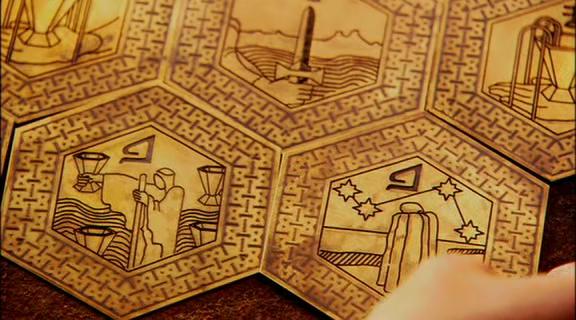
In the Children of Dune mini-serie there is a scene where Princess Irulan visits Gaius Helen Mohiam who is inside a cage, where she seen laying down hexagonal tiles. You can hear a kind of metalic sound when she lays down the tiles, suggesting that the tiles are made of a solid material. The scene is based on the sixth chapter (not counting the intro chapter) of Dune Messiah. There it describes that she 'had been spread a deck of the new Dune Tarot cards.' At the end of the chapter she returned to her tarot cards, getting the Kwisatz Haderach of the Major Arcana and Eight of Ships thinking: 'the sibyl hoodwinked and betrayed'. These seem to matched with the The World and the Eight of Cups cards of the current day tarot. In Dune Messiah it is said that so many people using the Dune Tarot muddled with prescience.Some weeks ago, someone posted three images that are watermarked with the text The Prop Shop of London. (Searches for that name link to propstore.com.) So, it seems that the tiles were sold at one point. I wrote an image manipulation program for the MySample editor to extract the tiles and combine them into a single image, which is show below:

I spend some trying to match the different tiles with the tarot. The last two rows match with the Suit of swords and Suit of goblets. The symbols near the top of the tiles, seems to be numbers. For the top row, it is not clear to me whether these belong to Major Arcade or the Suit of coins. This taking into account, I would come up with the following matchings:
- Ace of Coins or The Sun
- Two of Coins (often depicted with the sea at the bottom).
- The Hanged Man
- Four of Coins
- Ace of Swords
- Two of Swords
- Three of Swords
- Four of Swords (with the Sandworm)
- Ace of Cup
- Two of Cups
- Three of Cups
- Four of Cups
It is possible that this tile set consisted of more tiles than the one shown here. In a shot of the scene, two 'Ace of Cups' tiles are visible. Implying that there were several tiles of the same design used. All tiles can be seen layed in the same orientation, whereas in tarot the orientation can play a role where an upside-down card is given a different interpretation. An hexagon tile can have a total of six orentations.
In the first months there has been a flood of first time reaction videos:
- Let's see the HYPE about “DUNE” First Time Watching/ Movie Reaction & Commentary
- ACTRESS REACTS to DUNE (2021) FIRST TIME WATCHING *IT'S INCREDIBLE!* Dune: part one movie reaction
- DUNE is Pure Cinema (2021) Movie Reaction | First Time Watching in 3D (Not a real first reaction.)
- Dune | Star Wars in the Desert?! | First Time Watching • Movie Reaction • Movie Commentary • Review
- *DUNE: PART ONE* sand gets everywhere: BLACK PEOPLE REACT
- Dune (2021) ♡ MOVIE REACTION - Getting Ready for Dune Part 2! (Not a first time reaction)
- Foreign Girls React | Dune | First Time Watch
- Totoro REACTS to DUNE PART 1
- Dune: PART ONE (2021) MOVIE REACTION | FIRST TIME WATCHING!!
- DUNE PART 1 (2021) | FIRST TIME WATCHING | Reaction & Commentary
- Dune (2021) FIRST TIME WATCHING! REACTION
- DUNE (2021) Movie Reaction! | First Time Watch! | Timothée Chalamet | Zendaya | Oscar Isaac
- STAR WARS FAN WATCHES DUNE!! MOVIE REACTION!! (First Time Watching)
- DUNE MOVIE REACTION | FIRST TIME WATCHING
- Filmmaker reacts to Dune (2021)
- *DUNE Part 1* left ME in AWE 🫢😲 Movie REACTION & REVIEW
- DUNE (2021) MOVIE REACTION | FIRST TIME WATCHING
- I UNDERSTAND THE HYPE NOW! DUNE | FIRST TIME WATCHING | MOVIE REACTION
- Dune (2021) First Time Watching! | Movie Reaction
- *DUNE* is better than *STAR WARS*
- Dune (2021) | REACTION (First Time Watching)
- Dune Movie Part One First time Watching Reactions
- DUNE PART 1 Reaction - THAT WAS INCREDIBLE!!!
- DUNE (2021) !! | FIRST TIME WATCHING! | Movie Reaction Part 1 Part 2
- DUNE (2021) Movie Reaction! | First Time Watch! | Timothée Chalamet | Zendaya | Oscar Isaac
- What A SciFi Experience 😲 | Dune Movie Reaction
- *Dune Pt.1* was Flat Out AMAZING!│First Time Watching│Reaction/Review
- Watching Dune for my FIRST TIME EVER
- I Forced My Friends To Watch: Dune (2021) | REACTION
- “Fear is the mind killer” | Dune Movie Reaction
- Dune: Part One (2021) | BOOK READER REACTS
- FIRST TIME WATCHING *Dune*
- DUNE (2021) REACTION | Dylnesius
- Dune 2021 FIRST TIME WATCHING! REACTION
- DUNE (2021) FULL REACTION | I am in awe of this adaptation! #duneparttwo #reaction
- Dune (2021) | Movie Reaction | INDIAN First Time Watching (Two Indian guys explaining the movie to a third who has not seen it yet.)
Links
Friday, April 19, 2024
City of Illusions
I finished reading the book City of Illusions by Ursula K. Le Guin, which is the second book in the omnibus Worlds of Exile and Illusion and which I started reading on April 12. I felt that the middle part of the book was rather boring. Le Guin seems to have a preferance for writing about characters traveling through cold and hostile landscapes. This is the third novel I read where this takes a sizable part of the story. Then end however was a real page turner. Again the story ends quite abruptly. Not very satisfying. An interesting read anyhow.Wednesday, April 17, 2024
Books
At 10:21:04, I bought the book Quadrivium: rekenkunde, meetkunde, muziek en astronomie voor iedereen written by Miranda Lundy written in Dutch, published by Librero in 2013, and translated by Cornelis van Ginneken and Ireen Niessen from Quadrivium written in English, ISBN:9789089983039, from charity shop Het Goed for € 2.00.At 14:44, we received the book Historische wegenatlas NL: Nederland in beweging written by Martin Berendse and P. Brood in Dutch and published by Uitgeverij WBooks in 2024, ISBN:9789462586116, which we bought yesterday online for € 39.95.
Tuesday, April 16, 2024
Hare Krishna Tree
When I opened the Great Trees of New York Map, which I bought last Wednesday, I found a mentioning of the Hara Krishna Tree. I found descrition of these on the Atlas Obscura and the Official Website of the New York City Department of Parks & Recreation websites. The latter mentions that it was on October 9, 1966, that Prabhupada and his followers sat beneath this tree and held the first outdoor chanting session outside of India. They very probably also chanted the famous Hara Krishna mantra. One of the people present was Allen Ginsberg. For the International Society for Krishna Consciousness the chanting session is seen as the start and the movement. When I was a teenager, I encountered Hara Krishna followers on the Dam in Amsterdam. I felt a little bit attracted to that life style at the time being. In 2016 and 2017 when I joined some mantra singing sessions, I also sang the Hara Krishna mantra, but a bit more melodic than in most of the videos that there are on YouTube. One that comes a bit close is this one.Straight skeleton
In the past month, I worked on implementing an algorithm for constructing the straight skeleton of an area defined by polygons (with holes). I really struggled with implementing this and tried several approaches. I did consider a sweep algorithm were edeges are added one by one using doubly connected edge list, but that required a lot of modifications. So, I ended up looking at a method of constructing the area adjecent to a given edge making use of all the edges that are visible from this edge based on the triangulation code I wrote last year January. That approach took me longer than expected. And even now it looks like it is not flawless and needs more work for some edge cases. At least, I feel confident to present it. See this page for the demo. I probably will continue working on that page after this post, fixing bugs, cleaning up the code, and present the underlying code in a readable manner. I have no idea of my code matches any of the other implementations.Saturday, April 13, 2024
In to the city
At Fotogalerie Objektief I saw the exhibition WOW, a World of Wildlife with photograpsh by Edgard Berben. At Concordia, I saw the exhibition by Roland Farkas.Friday, April 12, 2024
Planet of Exile
I finished reading the book Planet of Exile by Ursula K. Le Guin, which is the second book in the omnibus Worlds of Exile and Illusion and which I started reading on April 6. I found this book a bit more exiting than the first book. I felt that it ended quite abruptly.Thursday, April 11, 2024
Rondom PS
Conny and I visited Peter Struycken and together with him, we went to see the exhibtion Rondom PS: Peter Struycken en bevriende werken (in English: 'Around PS: Peter Struycken and befriended works') at Gorcums Museum. We both enjoyed this exhibition very much. It gives a good overview of his works. I do like the newest incarnation of his SHFT 34 work, now in the form of a mini computer in a wooden frame of which there were two on display. Besides the works by Peter Struycken, I found the following works noteworthy:- Untitled, Charlotte van Pallandt, 1995.
- Untitled, Willem Hussem, 1967.
- Dutch Treat, Carel Blotkamp, 2004.
- Untitled, Rob van Koningsbruggen, 1974.
- Oppervlak tussen cirkel en cirkel, Ad Dekkers, 1972.
- Plotter drawings, Floris van Manen, 2016-2023.
- Wonen, Rein Draijer, ca. 1972.
- Untitled, Geert Lap.
- Fracs 3, Hoos Blotkamp, 1992-2014.
- Turmac, Charley Toorop, 1927.
- Untitled, Eja Siepman van den Berg, 1990.
Afterwards, we also brought a short visit to the exhibition Rondom 3D with works by:
Wednesday, April 10, 2024
Rotterdam
We left the hotel a little after ten in the morning and took the metro to the metro station Leuvehanven. From there we walked along the Nieuwe Maas. We saw the moter yaught Sherakhan. We arrived at the pedestrian and cyclist entry of the Maastunnel and used the wooden escalators to get to pedestrian tunnenl. We walked into the tunnel until where it gets level. This is about 20m below sealevel. I remember having visited this tunnel as a child. Probably just before the summer holidays of 1967. Interesting to visit it again after almost 57 years.From there we walked to Depot Museum Boijmans Van Beuningen through the park where we saw the artwork Lost Pearl by Madeleine Berkhemer. Before going inside, we took some pictures of ourselves in the reflective plating on the outside. I found the following art works noteworthy:
- Self-Portrait, Edgar Fernhout, 1953-1954.
- Self-portrait against a Wall, Charley Toorop, 1925.
- Self-portrait with Brush and White Cloth, Carel Willink, 1936.
- Landschape with tower and circular building, Hercules Segers, 1625.
- Self-Portrait, Marius Richters, 1901.
- Untitles, Christopher Wool, 1990
- Infinity Mirror Room - Phalli's Field (Floor Show), Yayoi Kusama, 1998.
- R 74-9, Jan Schoonhoven, 1974.
- Grey, Orange on Maroon, No. 8, Mark Rothko, 1960.
- Computerstructuur IIA-'72, Peter Struycken, 1972.
- L'Oise à Pontoise au temps gris, Camille Pissarro, 1876.
- View of Saint Mary's Square and Saint Mary's Church, Utrecht, Pieter Jansz. Saenredam.
- Sea (Brisants de la mer du Nord), Jan Toorop, 1895.
- Champ de coquelicots, Claude Monet, 1881.
- Ths Shooting Gallery, Pyke Koch, 1931.
- Couple, Pablo Picasso, 1970.
- Self-Portrait, Charley Toorop, 1926
- Self-Portrait, Carel Fabritius, circa 1645
- The Earring, George Hendrik Breitner, 1893.
- Impressions d'Afrique, Salvador Dali, 1938.
- Composition with colour fields, Piet Mondriaan, 1917.
- Le doigt sur la joue, Kees van Dongen, 1910.
Form the depot, we went to Het Nieuwe Instituut to see the exhibition REBOOT: Pioneering Digital Art. I found the following works noteworthy:
- Komputerstrukturen 4a, Peter Struycken, 1969-1970.
- Computer Structuren 5A, 1970-1971, Peter Struycken, 1970-1971.
- Computerstructuur I-'72, Peter Struycken, 1972.
- Ideofoon I, Dick Raaijmakers, 1970-1973
- PATIAL SOUNDS (100dB at 100km/h), Marnix de Nijs & Edwin van de Heide, 2000-2001,
- The Hands, Michel Waisvisz, 1984
- http://wwwwwwwww.jodi.org/, Jodi (Joan Heemskerk and Dirk Paesmans)
- Emoji is all we have, Luna Maurer & Roel Wouters, 2023.
- Agora Phobia (Digitalis), Karen Laucel & Hermen Maat.
- Breed, Erwin Driessens & Maria Verstappen, 1995-2007.
- Points of view, Jeffrey Shaw, 1983.
- Homā's Phantom, Ali Eslami, 2023.
- The Senster, Edward Ihnatowicz, 1968-1970, (I saw it when it was on display from 1970 to 1974 at the Evoluon).
We took the metro to Delfshaven, now a borough of Rotterdam. While walken there, we past the shawarma store "El Aviva" where the Kapsalon dish was first prepared. We walked through the area where the original city Delfshaven started as the harbour for Delft. From there we walked to city center along the road called Nieuwe Binnenweg. At number 146, I noted a space invaders tile, which is on the website of Invader for Rotterdam. Conny knows this road from the time she worked in the neighbourhood. We briefly visited the bookshops Van Gennep and Donner. In between the visits we had some icecream at McDonalds. We had dinner at Urumqi restaurant, an Uygur restaurant. Conny had a (rather spicy) noddles dish and I had the Urumqi polo dish, which tasted just like I remembered from having it before.
Tuesday, April 9, 2024
Erasmusbrug
Early in the evening, Conny and I arrived in Rotterdam and checked-in at the Art Hotel. A bit later than we had planned due to some stupidity of mine. We crossed a street to find some place to eat. The Amaana restaurant was closed due to Eid al-Fitr. Around the corner we found Eethuis Nakiş, a Turkish restaurant, where we ordered Kapsalon with chicken. From there we walked to Erasmusbrug (English: "Erasmus Bridge") where we took some pictures. One of the pictures Conny took, is shown below:

Monday, April 8, 2024
Link
Saturday, April 6, 2024
25.3° Celsius
The temperature at Twenthe Airport has gone up to 25.3° Celsius, which breaks the previous record of 23.3° on this date in 2020. This means we have the first regional summer day, which is defined as the temperature getting above 25°C. Yesterday, the maximum temperature was 17.0°C and the prediction for tomorrow is 18.6°C. This warm day is caused by Storm Kathleen, which pushes a lot of warm air from the South as can be seen on this Animation on instagram by Scott Duncan. We cleaned the bench outside and spend some time reading there. In out North facing garden, I saw the temperature go up to 27.c°C on a digital thermometer. I have no idea how accurate it is, but I do know that in the city it is often a bit warmer than in the open field.Trying revng more
From someone on the Discord 'orchestra' channel I got some help explaining what commands to use. I used the following command on the cc_x86 executable with a size of 14.2Kbyte, which is produced during the execution of the live-bootstrap from the file cc_x86.M1:revng artifact --analyze decompile-to-single-file cc_x86 | revng ptml >cc_x86.cThis produces a cc_x86.c file of 20Mbyte file with 1530 switch-statements with a total of 52200 cases. It also has 9863 variable declarations and a large number (17889 or more) of assignment statement where one of the variables is simply assigned to another (possibly with a cast). Not something that is very useful for understanding the binary. I guess that the the rev.ng decompiler has problems with the non-standard calling convention that you do find in binaries created with hand coded assembly.
Rocannon's World
Today, I finished reading the book Rocannon's World by Ursula K. Le Guin, which is the first book in the omnibus Worlds of Exile and Illusion and which I started reading on December 2 last year. The main part of the story covers a long and sometimes dangerous journey over the surface of a planet, much like the one found in The Left hand of Darkness. Honestly, I find this way of telling a story, with a single story line, a bit boring, especially when it is only in the last chapters and epilog somethings are suggested that place the whole story in a different light. Spoiler: Did I understand it correctly that it was totally not accidental that Rocannon met the Ancient One and that entity was the 'shadow' that he had sensed before?Friday, April 5, 2024
Trying revng again
Recently, the rev.ng decompiler has gone open source (announcement). On January 16, I reported about trying it. I encountered a bug that I did report as issue #345. In the past days, I did some debugging myself with respect to this issue and even made some suggestions about the cause. I also studied part of the code base. Today, the issue was fixed, but when I looked at the commit. with the fix, I realized that it was something that I would have been able to find myself, not having some knowledge about the development of the code. It looks like at some point a change was made where one of the uses had not been updated yet. Now the command that I used in january did work and resulted in a large file cc_x86.translated. It looks like a binary file. I studied the documentation, but I failed to figure out how to decompile the binary. Maybe the documentation is out-dated. I did enlist for the closed beta for the UI, I presume, from which the revng back-end is called.Saturday, March 30, 2024
Into the City
I went into the city. I visited two exhibitions at Concordia. I first saw the short documentary Kitten or refugee (in Dutch Kitten of vluchteling?) by Tina Farifteh, which also had some fragments of Frans de Waal, you died some weeks ago, about empathy. The second exhibition was Inkspot 2023 with a selection of the best political cartoons that appeared in Dutch newspapers. After this, I went to open day of TkkrLab. There I saw an automated version of RoboRally that had scanners for the cards and and applied the moves automatically using a mechanism below the board. It was build by one of the members of TkkrLab. Quite impressive.Friday, March 29, 2024
Four chestnuts and three heads
Today, I brought four chestnuts and three 3D printed Einstein heads home from my office. The chetsnuts I must have been picked up in the past four years from the street. The 3D printed heads might be based on BUSTA 0585. I got those three heads for a co-worker for coming up with an efficient algorithm for calculating the 3D offset for slicing primarily using the routines of the Clipper library, which is a library for performing operations on polygons.Tuesday, March 26, 2024
Typographic Matchmaking
I finished reading the book Typographic Matchmaking: Building cultural bridges with typeface design by Huda Smitshuijzen AbiFarès. I already started reading the book on September 14, 2023 but did not get far. After having read Taras Typeface: Graduation project I wanted to continue reading it but I could not locate the book. Some weeks ago, I found it again and started reading it afresh. I already bought it on February 26, 2016. The book is about the Typographic Matchmaking Pilot Project during which five Arab-Dutch design teams created Arabic companions for Latin fonts. The book starts with an introduction and history of Arabic type followed by a description how the five teams worked together on the project and their results. It also gives some information about the ten type designers involved in the project including some samples of their work. The book also includes a CD with the fonts. It was interesting to read, but even more so for someone who has a greater knowledge of the Arabic script and the various types and of the principles of type design, both of which I am lacking. A short introduction to Arabic type design would have helpfull. I found this interesting page: Writing Systems And Calligraphy Of The World.Sunday, March 24, 2024
Memory layout
I wrote a small C program to find out something more about the memory layout of a program that is being executed on Linux. The program returns different addresses every time it is executed. I think this is because of the address space layout randomization that Linux has implemented. It looks like two memory ranges are used. One for the stack (that grows downwards) and another for the code, the global variables, the string constants, and the heap (that grows upwards). Before the 'main' function is called the stack is filled with the values of environment variables (as returned by the env command) in reverse order, the command line arguments, also in reverse order, the array with pointers to the environment values terminated with a null value, and an array with pointers to the command line arguments, also terminated with a null value. Assuming that the parameters of main are named argc and argv then argv[argc+1] points the value of the first environment variable. The code of the program I used is:
#include <stdio.h>
#include <malloc.h>

void func()
{
    int a;
    printf("%p &a\n", &a);
}

int global;
const char *hello = "hello";

int main(int argc, char *argv[], char *env[])
{
    int m;
    printf("%p &global\n", &global);
    printf("%p hello\n", hello);
    printf("%p world\n", "world");
    printf("%p func\n", func);
    printf("%p argv\n", argv);
    printf("%p &m\n", &m);
    for (int i = 0; i < argc; i++)
        printf("%p %s\n", argv[i], argv[i]);
    printf("%p env\n", env);
    for (; *env != 0; env++)
        printf("%p env %30.30s\n", *env, *env);
    func();
    for (int i = 0; i < 10; i++)
    {
        char *a = (char*)malloc(10*i);
        printf("%p alloc\n", a);
    }
    return 0;
}
Friday, March 22, 2024
Natural well
In the past months, some work has been done under the bicycle path along the road called Hendrik Ter Kuilestraat where water kept on welling up in the past years. I repored something about this on Wednesday, February 7, 2018. It is at location 2 as shown in the picture I described on Thursday, March 26, 2015. I noticed that the area is dry now. But now there is water welling up at the road called Lonnekerbrugstraat as shown in the picture below. This is close to area shown in a picture I mentioned on Tuesday, April 7, 2009 as 'the second spot'. It looks like it has moved to an old location.

Thursday, March 21, 2024
Working in the garden
In the afternoon, Conny and I were busy in the the garden. We first went to a local garden center to get some more flower seeds, flower bulbs, (small) fruit trees, fertilizer, a compost sieve, and a bottle of Mrs H.S.Ball's Chutney Hot. We removed some dried flowers. I sieved some compost and used it when planting the fruit trees. We also planted some of the flower bulbs.Links
- The Real C++ Killers (Not You, Rust)
- Spiral: Software/Hardware Generation for Performance
- Numba is an open source JIT compiler that translates a subset of Python and NumPy code into fast machine code
- ForwardCom: an open forward-compatible instruction set architecture
- difftastic: a structural diff tool that understands syntax.