Sun Mon Tue Wed Thu Fri Sat
          1   2   3   4   5
  6   7   8   9  10  11  12
 13  14  15  16  17  18  19
 20  21  22  23  24  25  26
 27  28  29  30  31
|
Magazines
I received four magazines with some article about Peter Struycken in the mail which I bought from Artentique for € 17 including shipping. These are:
- Museumjournaal 17.5, October 1972
with "peter struycken, enkele van zijn visuele structuren nader bezien" by
Johannes van der Wolk on pages 204-208.
- Museumjournaal No.7, 1890
with "Peter Struycken en de Academische Traditie" by Hoos Blotkamp on
pages 312-324.
- Ruimte, April 1996 with
"Een inspirend samenspel" by Annelie David in cooperation with Saskia Wolda
on pages 28-31.
- Kunstbeeld 11 1999 with
"De Kleuren van Struycken" by Saskia Monshouwer on pages 20-23.
I discovered that I already have a copy of the last magazine.
The article by Johannes van der Wolk has some interesting tables with respect
to Komputerstrukturen 4 and
4a. I checked these tables by
adapting the scripts so they would return compatible data. I discovered only
one little mistake. The last line of the second table should read the numbers
"10 21 82 - - 9 3" instead of "10 23 80 - - 9 3". This table does include
the count of 2 for code 14, which is refers to as 'module 4' in the article,
for the second group of five columns (of two wide). The author notices that the
distribution used in Komputerstrukturen 4 and 4a is very similar except for
the fact that different codes are used. In the third table he gives what he
thinks was the input distribution that Struycken used. But this does not
match with the input as described in P. Struycken from 1976. He does report that there is an error in
the reproduction of Komputerstrukturen 4a in P. Struycken komputerstrukturen from 1970, where I did find
ten errors.
Calender and invitations
I received some materials with respect to Peter Struycken, which I ordered from André Swertz Antiquarian Booksellers. The consist of a calender and
some invitations. In more detail in order of date:
50%
At bookshop De Slegte they now raised
the off percentage for books on sale from 30 to 50. At 13:38, I bought
the book De Bril van Buddy Holly by Boudewijn Büch, ISBN:9789029563284 for just € 1,25.
Snow prediction
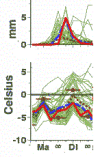
The 10 day ensemble predictions of the Royal Netherlands Meteorological
Institute for today predict some snow in the first half
of next Tuesday. The image on the right is showing the relevant parts of the
temperature and precipitation scales. The temperature will likely be below
zero during that day, but not for sure.
Lately, I have been thinking about an application for manual Structure from Motion. Today, I came along The CImg Library for image manipulation and also OpenMesh: a mesh implementation based on half edges. This is maintained
by Computer Graphics Group at
RWTH Aachen University. I discovered that they are also doing some research on
image
localization using Structure from Motion. Some code can be downloaded, but
only for Linux. Then I found the Open 3D
City application for manually modeling a city in 3D from arial pictures.
This evening, I downloaded the program. It looks much like what I have in mind,
but it only works on one fixed data set, which is downloaded from a website,
and it works with solids, not a triangular mesh, as I had in mind. I watched
the instruction movies (they are in German, but I have no problem understanding
that language) and played a little with, to discover that it is not easy.
Picture
Paul van Norden, an old
friend, visited us at the nursing home. Li-Xia had to
laugh a lot. We also walked around the building and Paul took some pictures
of us. (More of his pictures can be found on his website.) On the right is
one taken in the roofed 'garden' in the middle of the building. Li-Xia likes
this place for some reason. She often walks around and looks at her reflection
in the large glass windows. Communication with Li-Xia has become more and more
non-verbal. Talking has become almost useless, also because she mumbles in
Chinese mostly. But she still speaks with her face and I have become to know
her in a new way, understanding her needs and moods better and better.
At 16:56:17, I bought the following items during the winter sale of
Bookshop Broekhuis:
- Heer en meester, een liefdesverklaring by Edith Ringnalda,
ISBN:9789038894256, for € 8.75.
- Unforgettable Neighbourhood: Proposal for Permanent Chalk Drawings
in the Moscou District of Ghent by Bart Lodewijks, ISBN:9789077459485, for € 3.75.
- Marszwart & titaanwit: het beeldend werk van Jan Wolkers
by Onno Blom and Irma Boom, ISBN:9789023430001, for €7.90.
- Moleskine® Ruled Notebook Carnet Ligné for € 5.75.
Light snow
Yesterday evening we got a little snow. During the
night and the morning there was some more light snow. More snow is coming
for tomorrow as predicted last Friday, but it seems
it is only going to fall in the Southern part of the country and maybe we
do not
9 cm of snow!
Lots of snow this morning in the Netherlands, leading
to a record traffic jam of 1007 Km on the highways. Especially in the
South and West part of the country there was a lot of snow. I measured
3.4±0.3 cm of snow around quarter to ten in our back garden. It
continued snowing till the evening. Around six o'clock in the evening, I
measured 9 cm of snow. Because temperatures will remain low the coming
five days, the snow is expected to stay for some time.
Lately, I have been thinking again about developing an application to create 3D
models from 2D picture/images, with a focus on manual modeling with support from
Structure from Motion methods. The idea is to draw
polygon meshes on the 2D images and generate a 3D model with texture using
reverse ray-tracing, possibly taking into account shadows and automatic fill-in
for parts that have been covered. The closest existing (commercial) application
is ImageModeler™ from AutoDESK®, a free extension for their
various modelling packages. PhotoModeler
is another commercial application which performs Structure from Motion and allows
you to draw polygons based on the results to create a 3D model. An open source
application that is very similar to this is Insight3D (which I tested in November 2011).
You can also add your own feature points, but the interface is somewhat clumsy.
And the last application that I want to mention is Open 3D City, which I investigated last Friday, allows
you to draw solids based on images that have been aligned through Structure from
Motion. A could document for the techniques and algorithms behind this all is
Visual 3D Modeling from Images by Marc Pollefeys. I wonder what would the best approach to continue this
project: modifying Insight3D to my needs or starting from fresh taking the code
of the MySample editor as a starting point?
The polygon meshes (most likely triangle meshes) drawn on different images should be connected with each
other. It should be possible to have multiple meshes. Not every mesh has to
occur on each image and if one does, it should be possible to enable/disable
it per image. At most one mesh is active at any time, and edit operations
are performed on this mesh. One would start a new mesh on one image. First very
basic. Next one would copy this mesh on another image. For this one need the
notion of an active vertex of a mesh, which is the last vertex selected. In this
way vertices of the mesh are linked between images. Once this has been done
between a number of image, it is possible to start a Structure from Motion
algorith and estimate the 3D coordinates of the vertices and the relative
location and direction from which the images where taken. There are various ways
in which a mesh can be editted. One could add a new triangle on the outside.
In this case the new vertex needs to be copied to one of the other images. But
once that is done, it is often possible to estimates its location on the other
images. One could also create a new vertex inside an existing triangle and
divide the triangle in tree smaller triangles. In this case one could assume
that the new vertex is in the plane of the original triangle, and place it
accordingly to the other images on which the triangle is visible. Most likely
some difference should be made between vertices that are placed on an image
by the user and vertices whoes location has been estimated. Of course, when
more and more vertices are added, it is possible to generate a better
estimation. It could happen that estimated location of a vertices differes from
its given location on a certain images, maybe because of a mistake made by the
user. Maybe it should be possible to visually mark such possibly misplace
vertices. When one is positioning a vertices, it might be handy to mix the
image on the connected triangles with the contents of those triangles on the
other images, as to better judge the optimal location. (As an alternative,
one could also change the brightness to the degree that it matches with the
other images.) During such an operation it could be helpfull if the edges
of the triangles and the mouse cursor are hidden.
Amsterdam
This morning, I went to Amsterdam, because in the evening my employer was
giving New Year's reception with a dinner. I first went to bookshop De Slegte and bought the book
Geluid <=> Kijken: drie audio-visuele projecten = Sound <=> Sight:
three audio-visual projects by Ton Bruynèl, Dick Raaijmakers, and
Peter Struycken for € 20. The book
contains a program listing of the program used by Struycken and also three
record singles. At JOOT Books, I bought
kleur, ruimte en verandering = colour,
space and change by P. Struycken for € 8 and
Kunstopdracht P. Struycken, Expeditie
Knooppunt Post Utrecht for € 10. Furthermore, I went to
the bookshop of Mendo,
Bookshop Xantippe Unlimited, and Boekie Woekie, a bookshop that sells books by artists. Quite interesting,
but I did not stay long. While walking to square called Leidseplein, I also
went to bookshop Scheltema/Selexy, where I
looked around the computer science and mathematics department. In the afternoon,
I went to the library of Stedelijk Museum Amsterdam, where they have a large collection of books
about modern art. I requested for many books and materials. I took many
photographs of these, so that I can study them at home.
At the end of the afternoon, I went to gallery de Expeditie. They have many artworks by Peter Struycken, but not
on display. I talked a little with some lady, who also gave me some invitations
of previous exhibitions of Struycken.
Drifting snow
Yesterday afternoon, it started to snow again,
mainly drifting snow. This morning, I measured 9 cm of snow on a
flat table in our back garden. During the day it continued snowing with
drifting snow, sometimes stronger, sometimes less. I guess another one
or two cm of snow fell.
70%
At 14:27, I bought the little book Banksy: Myths & Legends by Marc
Leverton, ISBN:9781908211019, for € 2,08 (70% off) from
bookshop De Slegte. The book is about
Banksy, In the evening
I read the book. Funny.
Winter sale 75% off
This afternoon, I went to bookshop Broekhuis
to look at the winter sale where all books are 75% off the original price.
I also went to look at third floor where Miguel Dominguez was working on one of his chairs. I talked a little
with him. He is making art works out of old forniture. At 13:58, I bought
the book Surreptitious Software: Obfuscation, Watermarking, and Tamperproofing
for Software Protection by Christian Collberg and Jasvir Nagra, ISBN:9780321549259, for
€ 12.95, which is with 75% off.
Dear Esther
This afternoon, I downloaded and played the first person adventure
computer game Dear Esther. In a sense it is a very boring game, because there is not
much to do. No puzzles to solve like in Myst. But I still found it a very
interesting experience and I probably want to play it again. It is much like an
interactive movie. It took me about one and half hour to finish the game. I
somewhere read that the average game play is about three hours. But I guess, I
am a little experienced in finding the right path, and I also might have missed
some parts. I wrote down a game record, like I did for other games I played,
but I am not sure if I am going to publish it, because it is not really like
a game that you should do this. The only point of criticism I have, is that there
is no option to replay the narrative that is being played at certain points in
the game. As a non-native speaker, I would like to reread the text to fully
grasp it. If you don't want to buy the game, you can also watch
a full playthrough on YouTube.
But I am glad that I bought the game, because it will support the producers in
creating similar, maybe even more engaging, games.
This months interesting links
Home
| December 2012
| February 2013
| Random memories


 Friday, January 11, 2013
 Saturday, January 12, 2013