Saturday, October 24, 2026
Harvest
Even though it is already the end of October, we are still receiving a generous harvest every Saturday from the Herenboeren Usseler Es cooperative. Today, we were could pick out one pumpkin per 'mouth' from the selection laid out in the polytunnel. took two, because we have a subscription for two mouths.. I also collected two kilo of potatoes, some carrots (at least a kilo), two bunch of green beans (you have to cut of the beans yourself), and two heads of lettuce or endive. I was a bit late and got one of the last heads of head of romaine (if I'm not mistaken) and a large head of endive, of which there were still plenty of left. (Last week I also brought two large heads of endive home of which we gave away the largest.) We ended up having an endive salad tonight using part of one head, simply because it wouldnot fit properly in the fridge otherwise. At the "giveaway table," I also picked up four of the very last tomatoes, three of which are still completely green. We will see if they ripen. If not, we will have to come up with something else to do with them. We also still have a white cabbage and a red cabbage from last weeks harvest. We probably will made sauerkraut from one of them. We already did that this year with four other cabbages.Going into the city
I went into the city this afternoon. I first visited the exhibition Ontmoetingen en Observaties (which could be transalted to Encounters and Observation) with photographs by Rob ten Tusscher at photo gallery Objektief. Next, I went to Concordia, where I had a second look at the exhibition Paviljoen: Cross Media Design. (There is still no information about who made what.) I did notice some things, I had not seen before.Wednesday, October 21, 2026
Link: Spare room by Denis Iaquinta
Denis Iaquinta posted a link to the Guassian splat Spare room on Reddit to demonstrate his pipe line he has developerd. My first impression was that of a squatted home with aspecially due to the matras laying in the middle of the room. There are a number of interesting object in the room. A painting on the wall, a half finished puzzle on a table, four chair against the wall, a spiral object, a cloth on the wall, a foosball table, eight chairs placed in a cicle (are we going to have session), a cupboard with books inside, just to mention a few. You can look out of the windows on one side of the room, but not on the other side.Tuesday, October 20, 2026
Neocities: Coding Night
I went to the Neocities: Coding Night - Build your own digital garden event at Sickhouse. A presentation was given by the owner of theAlien Head Shit Kid site on neocities.org. I found a tutorial explaining how to deploy to neocities throught github workflow.Link: The Annotated VT100 Firmware
I found the link to The Annotated VT100 Firmware interesting because one of the first terminals I worked on was a VT100 compatible terminal. I owned a Teco VA120 terminal, which is now stil at TkkrLab. I also wrote some PASCAL modules for visualizing parsing on a VT100 compatible terminal: The screen management module and the Primitive terminal interface module.Sunday, October 18, 2026
Free form solution for The China Labyrinth
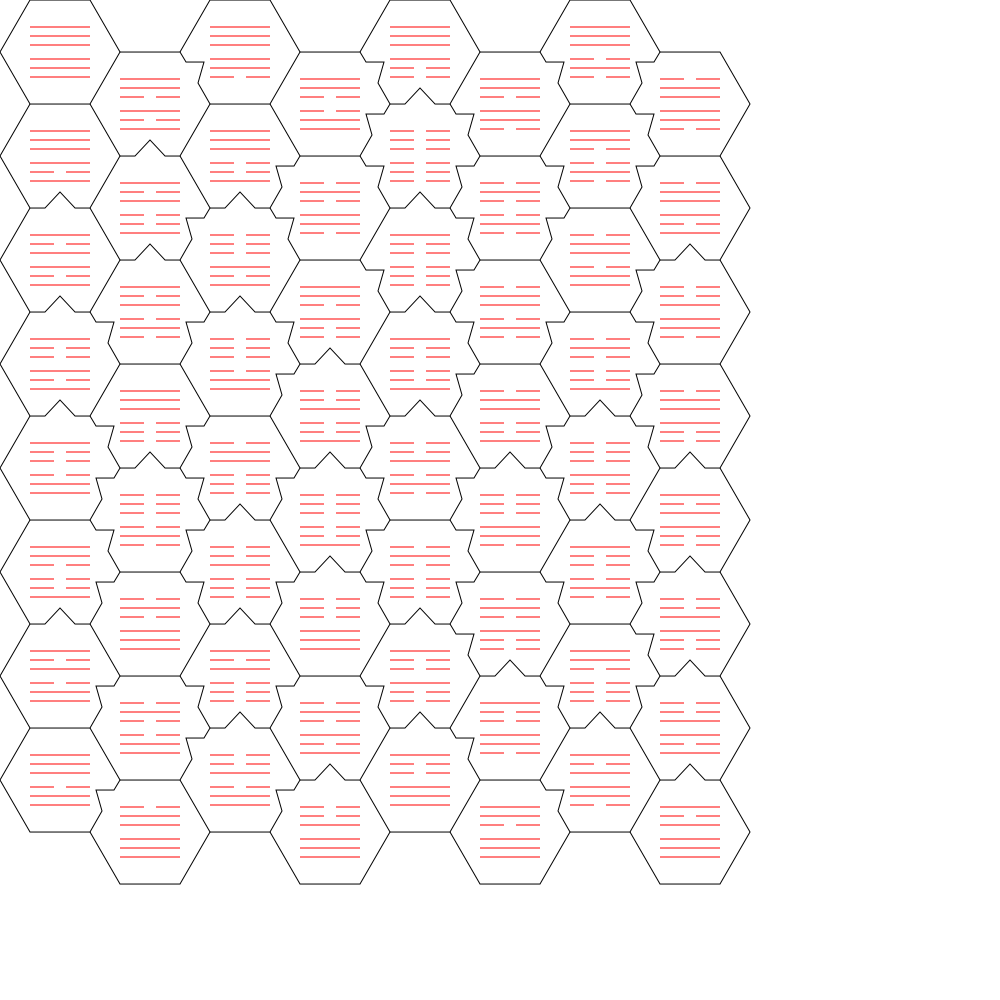
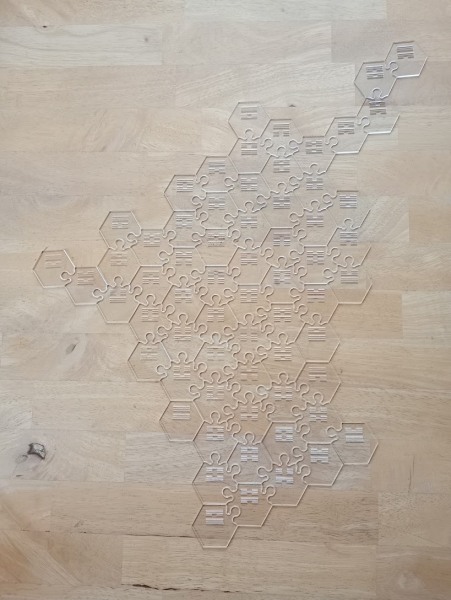
It turns out it is not so hard to find a solution for The China Labyrithn puzzle if you do not put restrictions on the border. The solution below was found by two people in about half an hour. The puzzle is made from pieces that I made with a laser cutter on September 22.
Saturday, October 17, 2026
Link
Wednesday, October 14, 2026
Carte Blanche
I went to see the exhibition Carte Blanche at B93. It was a double exhibition. Upstairs, was the work Fragments Unknown by Désiré De Lacy with photographs, projections on sheer curtains she had found on the street, and some audio playback. Quite interesting how she blends images in such a way that you at first do not notice it that they are blended. Downstairs was the exhibition of Guusje Slagter (Instagram). I took one of the cards that were offered with a still from the short film Het menselijk apparaat (The human apparatus).Tuesday, October 13, 2026
Bring Your Own Beamer
From 19:00 till 23:00, I showed my animation at the Bring Your Own Beamer event at TETEM art space. This is the fourth time I joined this type of event. The previous time was in March 10 earlier this year. This time, I decided The China Labyrinth as a homage to Christian Freeling. I did bring two physical copies of the puzzle with me. One made from wood and one made from perspex. The other artist and/or instalations at this event (if I did not miss one) were- Janine van Veen with a fragment from ICELAND
- Désiré De Lacy
- Owen Storni with Stubborn Cretin
- Vasil (VR world)
- Kuangyi
- Tessa Wiegerinck with a slide show of photographs of the iedereen is belangrijk project.
- Eve Haberman
- Ece Bakirham with Wishing Well
- Caroline Krajenbrink
- Luca Oosterloo with IMG_O443.JPG
- Bart Brinkman with Forrest Sequencer
- Didre Schutte
- Kashyap Krishna with The Spider & The Fly
- RAul Leal with an interactive pattern generator
- nonon creative studio with dataGOD - HYBRID
- Stef with image generation from noise produced by a no-input setup.
- Marijn Dijkmijer with Foul Play.
- Claudio Pestana with Divinaory Imaginaries
Sunday, October 10, 2026
Hackfest 2026
I went to Hackfest 2026 in Enschede. It was held at a different location then last year. It was at Sickhouse. I attended all the talks and in the breaks I looked around the various stands. At 12:15, I listened to the talk Introduction MsshCore by FrankkieNL. He showed how he uses a WisMesh Tag to connecto to the MeshCore through an app on his smart phone using Bluetooth. At 13:15, I listened to the talk BadgeTalk by Anne Jan Brouwer about all the badges that he was involved with in and about Badge.Team. At 14:15, I gave the talk Fast Linux bootstrapping. Afterwards, some people remarked that I maybe should have explained bootstrapping a bit earlier in the talk. At 15:15, I listened to the talk Printing in Seconds: Volumetric 3D Printing by Annalise Anspach. Quite interesting and many questions ans suggestions were made. At 16:15, I listened to the talks Parametric antenna design and Building with OpenSCAD by Andries Lohmeijer. In between the talks and afterwards, I looked around the stands. Some of these were:- PILED from England.
- Everyone can learn to solder like a pro! by Mitch Altman from Berlin.
- I played a bit with a MIDI controller and a modular synth by SoundForce
- Relions3D with 3D printed marble runner and B-lamp.
- Isetta Computer
- KITT Engineering with The Smart Pavement Tile.
- Space Clock
- Is a 1973 Pinball Machine a Computer? showing a Bally 'Monte Carlo' pinball machine. The owner showed the inside and the workings of machine. He was also in possession of the original schematics. It reminded me at the pinball machine we had in our dorm when I studied computer science.
- Nerds With Acid showing a modified drum machine besides some other things.
Photographs
I walked to Creative Broedplaats Enschede, who recently moved into a new building, to see the two exhibitions with photographs: A Ballroom of Eros by Anca Axinte and Image of Imagination by Boel Nordenstam.Thursday, October 8, 2026
Link
- Diggin' Demos: Dutch website about demo tapes from the eighties.
Wednesday, October 7, 2026
23.7° Celsius
The temperature at Twente Airport has gone up to 23.7° Celsius, which breaks the previous record of 22.4°C on this date in 1977.Tuesday, October 6, 2026
Duplicating code
In software engineering there is a rule to avoid duplicated code. An important reason is that if you duplicate some code and something has to be changed about it, it can happen that the change is made to just one of the copies. But there are cases where duplicating code is an option to consider. Sometimes when I am faced with such a situation, it can take me several hours to consider the option to duplicate the code. If you have written some function to interact with a global object and you are now faced with the situation that you also have to interact with another similar global object. To avoid code duplication you can extend all functions with an additional argument to specify with which of the two objects it should interact with. But in the situation that one part of the software always interacts with one of the objects and that another part always interacts with the other object, duplicating the code might be an option to consider, because the value of the additional parameter is always constant from the location where the function is called. Especially in an environment that is time critical, passing an additional parameter could have a some impact on the performance that could potentially be significant. In some cases, adding a new parameter to a function may also imply you have to add code to check if the parameter has a valid value.October 7: When developing in C, the C-preprocessor can be used to produce duplicate functions by including a file after some macro symbols have been defined.
Links
- Flatten SF: Find the flattest route between any two points in San Francisco
- BikeHopper: Bike navigation app for San Francisco Bay Area
Monday, October 5, 2026
Building live-bootstrap
This Saturday, I am going to give a talk with the title Fast Linux bootstrapping at Hackfest. For that I needed to know how long it takes to run live-bootstrap up to and including TCC-0.9.27. The README is not completely clear how to do it with chroot on Linux. I started with the following commands:
git clone https://github.com/fosslinux/live-bootstrap
cd live-bootstrap
git submodule update --init --recursive
I editted the file steps/manifest and removed everything after the line build: tcc-0.9.27. The reason to do it at this point is to reduce the number of files being downloaded. I continued with the commands:
./download-distfiles.sh
cp -r -t rootfs seed/stage0-posix/*
cp -r -t rootfs seed/*
cp -r steps rootfs
mkdir rootfs/external
cp -r distfiles rootfs/external
(The README does not mention that distfiles should be copied into the directory external.) I created the file rootfs/steps/bootstrap.cfg with the content:
ARCH=amd64
ARCH_DIR=/AMD64
FORCE_TIMESTAMPS=False
CHROOT=True
UPDATE_CHECKSUMS=False
JOBS=1
SWAP_SIZE=0
FINAL_JOBS=1
INTERNAL_CI=False
INTERACTIVE=False
BARE_METAL=False
DISK=sda1
KERNEL_BOOTSTRAP=False
BUILD_KERNELS=False
CONFIGURATOR=False
MIRRORS=file://
MIRRORS_LEN=1
Then issue the command:
time sudo chroot --userspec=${USER}:${USER} rootfs \
     /bootstrap-seeds/POSIX/AMD64/kaem-optional-seed
After 13 minutes and 37 seconds, this terminated with the error:
assert fail: 0

/usr/bin/tcc-mes abnormal termination, signal number = 11
Then I remembered that the 64 bits Intel x86 target (AMD64) is not supported. I decided to try to build the 32 bits target. For this I changed the first two lines of the file rootfs/steps/bootstrap.cfg into:
ARCH=x86
ARCH_DIR=/x86
and executed the commands:
rm -r rootfs/steps/mes-0.27.1/build
rm -r rootfs/steps/tcc-0.9.26/build
rm -r rootfs/usr
rm -r rootfs/tmp
rm configurator
rm script-generator
rm seed-full.kaem
time sudo chroot --userspec=${USER}:${USER} rootfs \
     /bootstrap-seeds/POSIX/x86/kaem-optional-seed
This finished succesful in 11 minutes and 38 seconds, which is a bit faster than building for the AMD64 target.
Links
- ExµArch: explore microarchitectures / a computer architecture playground
- Procedural-Cities
Sunday, October 4, 2026
FÆES-›!T at Black Brick
At end of the afternoon, I went in to the city. The sun was shining and it was warm authem weather, just over 20° Celsius, I guess. I bought a soft-serve ice cream and walked to Black Brick to see the exhibition that is part of the FÆES-›!T, the yearly Sustainable Fashop Art Event. The exhibition consisted of:- Hoeveel kun jij dragen (Dutch for How much can you carry?) by Emma Wijnsma
- Between Delicate and Violent by Şirin Bahar Demirel
- HIDE by
Adele Zavagno. It
consist of:
- A garment archetype by Adele Zavagno.
- Plastic Nostalgia by Patrick
- Heritage Canvas by Thuy
- Keepsake by Xoen Boerk
- Forgotten Canvas by Debbie
Saturday, October 3, 2026
Niño 3.4
Niño 3.4 stands for the are around the equator in the Pacific Ocean from 120 to 170° West and 5° South and North of the equator, which is an area of about 6 million square kilometer. The average surface temperature is taken as an indicator for how strong the El Nño is. In last week it is showing temperatures higher than ever on the Daily Sea Surface Temperature of the Climate Reanalyzer website. The temperature is getting close to 30° Celsius, which is 1.2° higher than the last record temperature in 2015 and 3.3° higher than the average in the years 1991 to 2020. The current El Nñno event is expected to peak around November or December. The Daily Sea Surface Temperature, World (the whole world between 60° South and North) is not at a record high but still higher since measurements started in 1981. Surprisingly, the Subpolar North Atlantic area is cooler than average, while being a bit higher during the past summer.Resizable panels
Some testing with dividing the page in three panels that can be resized. Started with some ideas from Google AI and then figured out a simpler method. I have not yet figured out how to get it working on touch devices.
Drag the grey bar to the right to see me grow and the middle window shrink smoothly.
Drag the grey bar to the left to see me grow and the left window shrink smoothly.
Drag the grey bar to the right to see me grow and the right window shrink smoothly.
I will scale dynamically based on whatever room is left over over here.
The HTML source for the above is:
<style>
.window-container { display: flex; height: 100pt; overflow: hidden; }
.scroll-window { background: white; padding: 10px; overflow-y: auto;
     box-sizing: border-box; }
#left-window { width: 33%; min-width: 100px; }
#mid-window { width: 33%; min-width: 100px; }
#right-window { flex: 1; min-width: 100px; }
.resizer { width: 4px; margin-left: 9px; margin-right: 9px;
     background: #999; cursor: col-resize; transition: background 0.2s; }
.resizer:hover { background: #444; }
</style>

<script>
function initResize1(e) {
    window.addEventListener('mousemove', StartResize1);
    window.addEventListener('mouseup', StopResize1);
}
function StartResize1(e) {
    const leftWindow = document.getElementById('left-window')
    const midWindow = document.getElementById('mid-window')
    leftWindow.style.width = (leftWindow.clientWidth + e.movementX) + "px"
    midWindow.style.width = (midWindow.clientWidth - e.movementX) + "px"
}

function StopResize1() {
    window.removeEventListener('mousemove', StartResize1);
    window.removeEventListener('mouseup', StopResize1);
}

function initResize2(e) {
    window.addEventListener('mousemove', StartResize2);
    window.addEventListener('mouseup', StopResize2);
}

function StartResize2(e) {
    const midWindow = document.getElementById('mid-window')
    midWindow.style.width = (midWindow.clientWidth + e.movementX) + "px"
}

function StopResize2() {
    window.removeEventListener('mousemove', StartResize2);
    window.removeEventListener('mouseup', StopResize2);
}
</script>

<div class="window-container">
  <div id="left-window" class="scroll-window">
    <B>Left Panel</B>
    <p>Drag the grey bar to the right to see me grow and the
    middle window shrink smoothly.</p>
  </div>
  <div id="dragBar1" class="resizer" onmousedown="initResize1()"></div>
  <div id="mid-window" class="scroll-window">
    <B>Middle Panel</B>
    <p>Drag the grey bar to the left to see me grow and the left window
    shrink smoothly.</p>
    <p>Drag the grey bar to the right to see me grow and the right window
    shrink smoothly.</p>
  </div>
  <div id="dragBar2" class="resizer" onmousedown="initResize2()"></div>
  <div id="right-window" class="scroll-window">
    <B>Right Panel</B>
    <p>I will scale dynamically based on whatever room is left over over
    here.</p>
  </div>
</div>
Friday, October 2, 2026
Authum crocus
On our walk, we sae the flowers shown below. Pl@ntNet gives it a 44% chance for being a Colchicum lusitanum, however that species is not known to grow in the Netherlands. This makes it more likely that it is a Colchicum autumnale, which is still rather rare in the Netherlands. On some map of observations I do see a red circle near where we live.

Thursday, October 1, 2026
Expo by Night × Gogbot
This evening, I went to Expo by Night × Gogbot. There were some projections from PLANETART, who also organizes the GOGBOT Festival, I saw the exhibition Paviljoen: Cross Media Design with works by students from the AKI. It was not clear who made which works. I did not attend the opening presentation. (They are often rather boring.) I took a photograph of the 23 names on the window outside. I can hardly believe that all those students are in the exhibition. The following, I figured out:- Puck Marneth with An alphabet made out coloured shapes, a sculpture made of two shapes made of wood, and a number of 'books' with sheets with cut-out shapes.
- Marius Hooft van Huijsduijnen with a stone and a number of reproduction of the stone made with various techniques.
- Esmé van den Brom with some notepads with on each page a colourful printed design.
- Emma Ouderkerk with Poppenhuis (Dollhouse) inspired by The Virgin Suicides
Wednesday, September 30, 2026
28.6° Celsius
The temperature at Twente Airport has gone up to 28.6° Celsius, which breaks the previous record of 25.7°C on this date in 2011. The temperature also seems to be the highest in the whole of the Netherlands.Tuesday, September 29, 2026
27.6° Celsius
The temperature at Twente Airport has gone up to 27.6° Celsius, which breaks the previous record of 23.5°C on this date in 2011.Sunday, September 27, 2026
Dier Day Rally
I accompanied Andy on the Dier Day Rally (Animal Day Rally) again, like I did three years ago. Besides Volkswagen Beetles and Citroën 2CV's, there was also one Citroën 2DS that are often nicknamed 'pike' in the Netherlands. Thus another type of car that is given a name of an animal based on it shape. During the lunch break in Weerselo there were some helicopter flights with participants. We did not participate.Book
This morning, I biked to the location of where Andy lives, which took me about 51 minutes. On the way back, I visited the trift shop Het Goed. At 15:40, I bought the graduation catalogue eindexamen december 1981 written by Sipke Huisman in Dutch and published by Academie voor beeldende kunst Enschede in December 1981 for € 1.99.Links
Saturday, September 26, 2026
Notebook
This morning, I received a copy of the notebook with various grid patterns designed by Simcha Ziya Moïse. I ordered it when visiting the Graduation Show at KABK, where she presented her graduation project Negotiating the Grid. I am not going to use it as a notebook, but will take it as an artist's book.Firday, September 25, 2026
Link
Wednesday, September 23, 2026
Link
Tuesday, September 22, 2026
The China Labyrinth puzzle
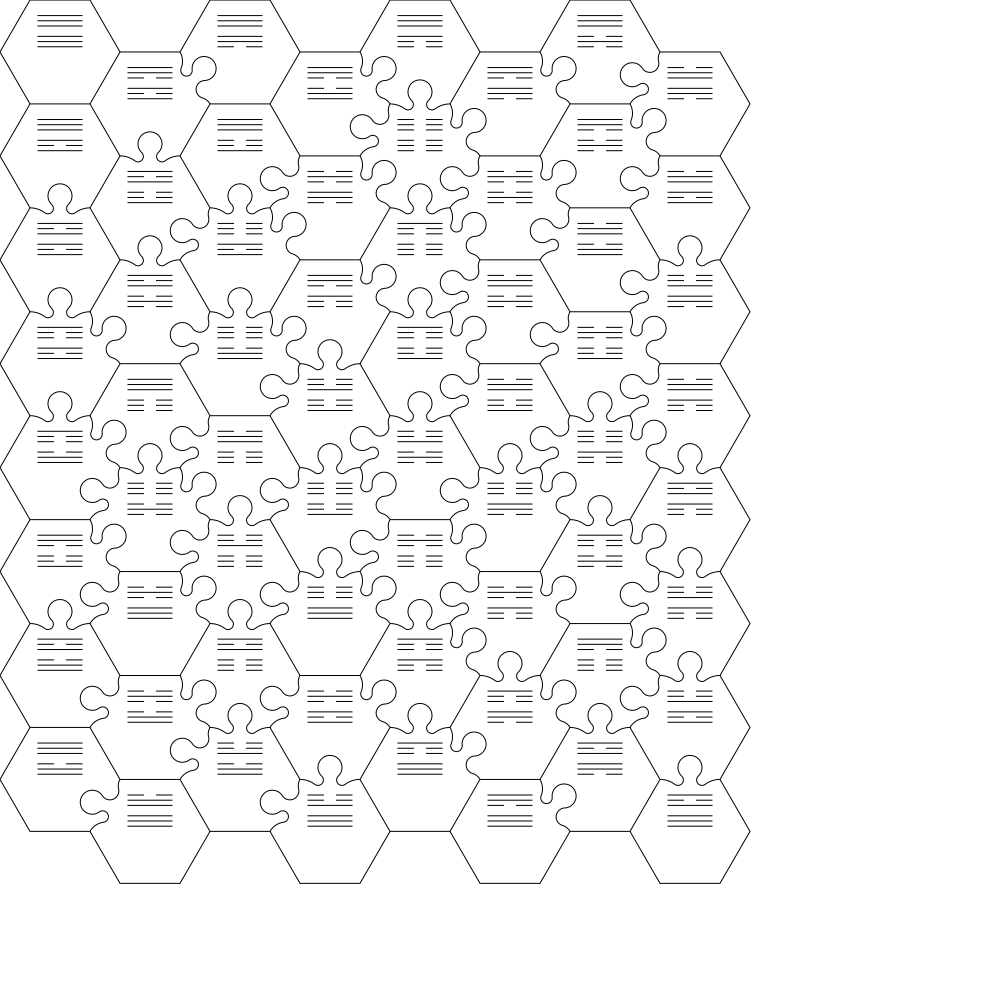
This evening at TkkrLab, I made some attempts to create a jigsaw puzzle from polymethylmethacrylaat based on the The China Labyrinth following a suggestion made by another member three weeks ago. I used the tools I shown with Puzzle piece shape designer and SVG for puzzle pieces for the a new version of the program hexapuszleSQ.cpp. My first attempt was with a rather large gap between the pieces. The gap proved to much to wide. I also discovered that it had some the same pieces, which should not be the case. I decided to add the I Ching hexagrams. For the second attempt, I reduced to a quarter. Because I had spend a lot of time removeing the protective plastic film from each of the pieces of the first attempt, I decided to remove the film before cutting. This turned out not such a good idea, as the pieces had brown spots and had dull spots. I also felt that there was still too much space between the pieces. For the final attempt, I used the SVG shown below. I was satisfied with the result.
Link
- Earth: A walkable, streamed 3D Earth built with Babylon.js and real-world geographic data.
Sunday, September 20, 2026
GOGBOT, Day 4
In the afternoon, I went to the city to join the GOGBOT festval again. At Concordia (Cinema), I saw:- Would Not Recommend, Ilja Kolosovs, 2026.
- Helenés (Apparition of Freedom), Christoph Draeger, 2005
- Putin's Ashes (Film), Pussy Riot, 2023.
- March ENKOR, Sluik/Kurpershoek, 1982.
I went to Metropool, the only locations had not visited yet, the volunteer again as an art guardian. There I saw:
- Relaying
Truth, consisting of five installations by students from Design Art
Technology at ARTEZ Arnhem:
- Artificial Representations
- No Binary Exists
- Dormant Data
- Correlation
- !أبحرم
- This Is How You Take Away Freedom (installation) by Isa Boonstra, aka Dirty Baszi, 2026. The installation contains a QR-code with a link to desprekers.com.
After the festival closed at 18:00, I helped a bit cleaning up the main area around the Oude Markt and also had some dinner. When I biked home, I made a small detour and collected five chestnuts from a tree in front of a Chinese restaurant 'Oriental City'.
Links
Saturday, September 19, 2026
Link
- SDCC - Small Device C Compiler
Firday, September 18, 2026
GOGBOT: Day 2
This afternoon, I visited various locations that are part of the GOGBOT Festival. I first went back to Sickhouse to see the performance by Mythe van Loon in her installation: Paultaar - This Is Our Church - Make It Fucking Louder. I was quite interesting and enjoyable.At Rijksmuseum Twenthe, I saw the exhibition Democracy Now. I found the following noteworthy:
- NOS Fake News, ViaOral, 2021.
- Inflammatory, Jenny Holzer, 1979-1982.
- Winst boven vrede | Profis over Peace, Umar Rashid, 2022.
- Propgagnada Theater, Video Study, Jonas Staal .
- Hate Breed, INDECLINE, 2019.
- APE, Seán Hannan, 2023-2024.
- L'État, c'est moi, Johannes Büttner, 2026.
- Untitled (Sword Dance), Erik van Lieshout, 2017.
- Masse | Masses, Peter Zegveld, 2018.
- Vox Populi, Peter Zegveld, 2018.
- Dolls vs. Dicators, Martha Colburn, 2010.
- Untitled, Erik van Lieshout, 2017.
- I want a President, Marina Naprushkina, 2021.
- Dialogues with the Future, Ursula Biemann, 2026.
- AI War Cloud, Sarah Ciston, 2024-ongoing.
- The Chronicle of Gaia, Carlijn Kingma, 2019.
- Nouveaux voyages de Mr le Baron de Lahontau, dans l'Amerique Septentrionale (book), Louis Armand de Lom d'Arce Baron de Lahontan, 1703
At TETEM art space, I saw:
- IMG_O443.JPG by Luca Oosterloo, 2026
- You May Also Like by Maria Mombers, 2026
- The Manosphere oracles by Bas Emiel Kusters, 2026
At the Oude Markt (square), I walked through the 12×12×12 meter GOGBOT ALIEN CUBE and saw:
- MONUMENT OF PEACE, HIMMELSBACH, 2026.
- CIRCLE A, Eoghan Ryan, 2024.
At Concordia, I watched a short video about the three-week GOGBOT x Concordia Productielab residency and I saw the results:
- Active Listening by Anna Musikhina.
- Synthetic Provenance of the Crystalline Yield ( Stream ) by Anahit Yakubovich.
- Elephant Woman: A History of Uploaded SELF by Evgeniia van Zonneveld.
- Fabricated Fears by Fenna Jensma.
- obscura flux by Sam Motti
At the Grote Kerk, I saw:
- Alle Macht aan de Kunst, Albert van der Weide, 2026.
- dataGOD_0.1, nonon - creative studio, 2026.
- Qwen Stefani Against Techfascism, !Mediengruppe Bitnik, 2025.
- HyperNormal, Noël Doodeman.
At Concordia (Cinema), I saw the installations and films:
- preconditions (In Medio), Sanne Scheepmaker.
- Fanfictional Politics, Pedro Gossler, 2022.
- I Am the Film Motherfucker, but I'm Real (film), Meowx2, 2026.
- The Hero (film), Marina Abramović, 2001.
- Patriotic (film), Benny Nemer, 2005.
- Heart Paper Transfer (film), Tamarma & Yamadatesla, 2026.
In the evening, I volunteerd as an art guardian in the Grote Kerk.
Thursday, September 17, 2026
GOGBOT: Day 1
This evening, I volunteerd as an art guardian at Sickhouse for the GOGBOT Festival. There, I saw the following art installations:- Optical Flow by Martyna Pekala
- Interceptor by Severi Aaltonen
- SaaS™☁︎℠: Working Towards Living by Varvara Pekhota
- TRANSCELESTIAL_XENOBODY:THIS IS MY/NOT YOUR PLANET by Rayan Naftchi
- Paultaar - This Is Our Church - Make It Fucking Louder by Mythe van Loon
- Healing is Consuming Me by Maroua Gaddur
- The Entity by three students from University of Twente
- Back to zero one by Katerina and her team of students.
Wednesday, September 16, 2026
Link
Tuesday, September 15, 2026
Free stuff
Someone at TkkrLab was cleaning two of his Samla boxes and donating things. I got the following items:- SCT013 from YHDC in box.
- OPN-2001 from Opticom.
- Small PCB with three 7-segement displays and a LED
- 3621AS - 0.36-inch Red 2-Digit CC LED 7-Segment Display.
- Two CC25XX Zigbee USB dongles in 3D printed cases. (One came with an antenna that another member took with him.)
- Canton-Power DDO603SA buck converter
- SanDisk 4GB DDHC Card
Monday, September 14, 2026
Link
Sunday, September 13, 2026
Again going into the city
I first went to Sickhouse where I went to see, or better, experience the immersive installation Dérive by Alexander Zanen, where you wearing headphones and a tracker move through the room while listening to a story. Although I am more of a visual person than an auditorial person, I did like it. Next, I went to Craft District Enschede to attend the volunteer meet-up for GOGBOT. On the way home, I went to Het Robson, which was open as part of the European Heritage Days. I saw the exhibition Diana Huijts with works by her. I have a book with prints from her series of lino prints about the alpha tower (the highest building in Enschede). I was a bit surprised by the great variation of techniques that were used for all the other works on display. I also talked a bit with the artists Jet Broekstra and Mark van Loon from Beeldbouw.Saturday, September 12, 2026
Going into the city
I biked into the city with just a shirt because the temperature was around 21° Celsius. At photogalary Objektief, I saw the exhibition De Adem van de Aarde (in English: The Breath of the Earth) with (digitally manipulated images from) photographs by August Langhout. From there I walked to the galery Beeld & Aambeeld where I saw the exhibition A Transatlantic Meeting with paintings by Maike Eilers and jewellery by Jillian Moore. I found the paintings interesting but a bit too constructed as if the artist first creates a digital manipulated image from pictures taken from nature and then makes a painting of it. I had a quick look at Concordia where there is a group of four recently graduated international artists who work on site-specific installations for the GOGBOT festival which opens next Thursday evening. There was not much to see except two of them working. I walked through the Grote Kerk (Great Church), which was open due to the European Heritage Days this weekend. It is the oldest building of the city of which the oldest parts date from around 1200.SVG for puzzle pieces
The path in SVG uses a different method for specifying an arc than JavaScript. In JavaScript you specify the coordinates of the center, the radius, the start and end angle and whether it clock-wise or counter-clock-wise. In the path command in SVG you can use the 'A' command to draw an arc from the current point to the next point specifying the size and orientation of an elipse (with three parameters) and the flags 'large-arc' and 'sweep', and of course the coordinates of the next point. I also realized that if you want to cut the pieces with a laser the width of the laser beam is probably two small to make the pieces fit easily and that you might want to specify the gap between the pieces. With the below you can specify gap. In the output it produces the values needed for generating the arc commands in SVG in the form of some code that can be included in a C(++) program. The position of the points are marked with a dot.
Link
- INSLIB: A portable C library for 3D navigation state estimation.
Thursday, September 10, 2026
Links
Tuesday, September 8, 2026
Simple Modbus storage server
In the past week, I have been working on a simple server for the Modbus protocol. The server implements a memory store. For a commercial project I am working on, I have to implement a Modbus client that talks with some Modbus server. Because I want to test whether this client is working correctly, I decided to implement a simple server on an ESP32-S3 microcontroller using ESP-IDF with PlatformIO in the intergrated development environment Visual Studio Code. I also took it as an opportunity to experiment with the TinyCoPoOS operating system that I developed almost two years ago and mentioned on November 17, 2024. I have finished implementing this in the repository ModbusClient for the 'native' environment with unit-tests, which means not yet actually tested on an ESP32-S3. That will be next step. I have made some changes to the TinyCoPoOS operating system that I publised about two years ago and pushed those to the repository.Friday, September 4, 2026
FLT has been formalized in Lean
Today came the news that FLT has been formalized in Lean by Claude, the AI agent by Antropic. FLT is short of Fermat's Last Theorem, a famous proposition for which the French mathematician Pierre de Fermat arounf 1637 claimed that he had a proof but that the proof was large to fit in the margin. Many mathematicians since then have tried to proof it but it was only in 1994 until Andrew Wiles proved it and formally published it in 1995. Lean is a mathematical proof assistant and a functional programming language. There are several other such proof assistants, but currently, Lean is the most popular. FLT is also the final theorem to be formalize in Freek Wiedijk's famous list of 100 formalization challenges and wraps up this 20-year=old benchmark. Lean has become the proof assistant that is being used to (dis)proof mathematical propositions and hypothesis with the help of AI agents. There was already work on the way as part of the Xena project to formalize FLT in Lean, but now Kevin Buzzard wrote the blog FLT: Anthropic has beaten me to it. But he goes on to explain that although it is a great achievement, the prove does not follow the proof given by Willes, which the Xena project wants to formalize and also make a dynamic document enabling humans to explore the proof. The proof that Clause produced consists of 13.4 million lines of code and Antropic is probably not going to work on making it human readable. It is definitely helping the progress of mathematics now that AI agents are helping to formalize proves in statements that can be automatically verified and push the use of proof assistance such as Lean.Wednesday, September 2, 2026
Puzzle piece shape designer
Yesterday, a member of TkkrLab suggested that I should have made the pieces of the puzzle into jigsaw pieces that actually stay together when locked in. I got this idea to make the shape out of connecting arcs and made a took to select design it. The tool is given below. The green line indicates the side of the piece. The grey lines connect with the three points defining the shape. The points can be moved by clicking with a mouse and drag them around. The radius of the middle arc can be adjusted with the slider. When this results in an impossible shape, a message is shown in the output window. The red lines shows the calculated lines for the connecting circle to the ends of the side. The output shows the radius and postions of the three points as percentages of the length of the side. It also calculates the area above the the side substracted by the area below displayed as a percentage.Some notes used for calculating the position of the red lines:
    a^2 + (b + x)^2 = (r + x)^2
    a^2 + b^2 + 2bx + x^2 = r^2 + 2rx + x^2
    2(b - r)x = r^2 - a^2 - b^2
    x = (r^2 - a^2 - b^2)/2(b-r)
Link
Tuesday, September 1, 2026
The China Labyrinth puzzle
This evening, I used the laser cutter at TkkrLab to create a puzzle (using a SVG file) based on the The China Labyrinth. Below a picture of the pieces (except for one):
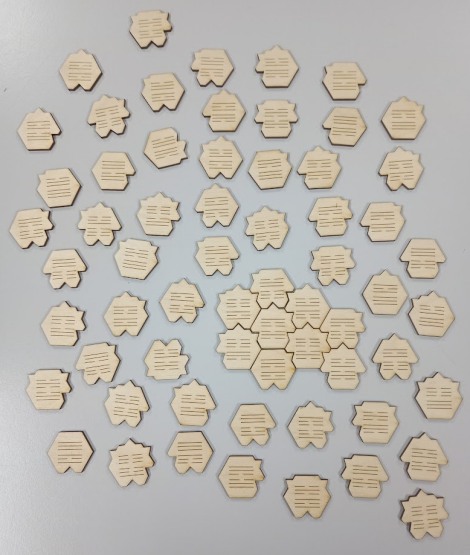
One of the members tried to put the pieces inside the frame where the pieces were cut from, but failed. There are somewhere between 10^20 and 10^22 solutions to the exact cover program that I use to estimate the number of solutions. On August 16, I already developed the program hexapuszleSQ.cpp to generate the input for exact cover program and to generate an SVG file when given the filename of the file with the solutions.
Link
Sunday, August 30, 2026
New floor at TkkrLab
Today at TkkrLab, we laid a new floor in the room where we usually get together. I forgot to bring my earplugs and ended up using two Nerf darts instead. The person who took the photo below called me 'fr-alien' in the caption. We managed to lay the entire floor, but not all the items are in their original places yet. I mainly focused on moving the cabinets and furniture, disposing of the old laminate, and bringing the new laminate upstairs.

Wednesday, August 27, 2026
Link
- RGS Brugstraat: XML format to perform tax declarations for entrepreneurs in the Netherlands (In Dutch)
Tuesday, August 26, 2026
First time watching: Dune: Part One
I watched many (if not all) reaction videos to Dune: Part One. YouTube has no longer the option to sort videos by when they were made, but it seems that recently there are some new first reactions videos, maybe due to the fact that Dune: Part Three is going to be released on December 18 this year. This evenint I watched the reaction video Dune: Part One | FIRST TIME WATCHING | Reaction by a women with the alias LiteWeight. I very much enjoyed watching this reaction video. She seems to very smart picking up many of the details. She is the only one who mentioned that when Paul was dueling with Jamis he struggled because he was trained to fight with a shield. In the book it writes 'They think Paul's toying with Jamis, Jessica thought. They think Paul's being needlessly cruel.'Monday, August 24, 2026
Modbus-RTU on ESP32-S3
Modbus is a fieldbus, an industrial computer networking protocol. Modbus RTU (Remote Terminal Unit) is the most common implementation for Modbus either as a 2-wire half-duplex over RS-485 connection or a 4-wire full-duplex over RS-422 or RS-485 connection. The most important difference between RS-422 and RS-485 is that RS-485 allows multiple drivers on the same wire, where the drivers are switched on only when needed, while with RS-422 they are always on. A typical use case for RS-422 is a point-to-point connection where both sides are sending data. The ESP32-S3 needs external an external receiver, such as the SP3490 or SP3491 from MaxLinear, for both RS-422 and RS-485 connections, or the MAX485 from Analog Devices for RS-485 connections. It seems that the statement that ESP32-S3 supports RS-485 means that the UART driver has the ability to detected collisions by snooping the receiving data while transmitting data and see if they are different (which is the case of a collision when two drivers transmit at the same time). There is a RS-485 example under the esp_driver_uart component and there is also a ESP-Modbus Library available, which also supports WiFi and Ethernet interfaces.Remark August 25: The ESP32-S3 also supports RS-485 in the sense that it has hardware to enable and disable the driver circuit, including some settings related to this.
Sunday, August 23, 2026
Amsterdam
In Amsterdam, I first visited the Rijksmuseum. I first at the collection. I found the following works noteworthy:- Children of the Sea, Josef Israël, 1872. (354)
- Girl in a White Kimono, George Hendrik Breitner, 1894. (363)
- The Singel Bridge at the Paleisstraat in Amsterdam, George Hendrik Breitner, 1896. (349)
- La Corniche near Monaco, Claude Monet, 1884.
- The Sea, Jan Toorop, 1887.
- Riverbank with Trees, Vincent van Gogh, 1887.
- The Singel near the Luthern Church in Amsterdam, Vincent van Gogh, 1885.
- Self-Portrait, Vincent van Gogh, 1887. (325)
- Wearfield, Vincent van Gogh, 1888.
- Vase with orchid decoration, Sam schelink, 1902.
- Whit and Block (no.27), Marlour Moss, 1948.
- Self-Portrait, Edgar Fernhout, 1957.
- Self-Portrait, Bep Rietveld, 1932.
- Self-Portrait with Flowers, Charley Toorop, 1933.
- Regels G.R. (Grouping Lines), Corrie de Boer, 1977.
- Dish Relief, Jan Schoonhoven, 1363.
- Variation on Circles IV, Ad Dekkers, 1967.
Next I saw the exhibition Up Close with works by Ed van der Elsken. I found the followings noteworthy:
- Men at Purmerend Livestock, 1972-1980.
- Women in qipao dress, Hong Kong, 1959-1960.
- Performers in an Asakusa nightclub, Tokyo, 1959.
- Self-Portrait with Ata Kandó in the mirror of their apartment, Sèvres, 1952.
- Contact sheet with Thomas, Madeleine and Juliette Kandè, Sèvres, 1950-1954.
- Juliette Kandè, Sèvres, 1950-1954
- London on the Left Bank (book by André Deutsch), 1956.
- Vali Myers on the street, Paris, 1950-1953.
- Vali Myer in the rain, Paris, 1950-1953.
- Priest in front of advertising poster, Paris 1950-1954. The priest holds a sign saying: 'Le vie est devence une comédie, une vaste comédie' (Life has become a comedy, one great comendy).
- Life in Colour, with projections of:
- Saint-tropez, France, circa 1975.
- Zandvoort, 1976.
- Daan Doras riding a horse, Edam, circa 1973.
- Havana, Cuba, 1967.
- Switzerland, 1967.
- Eye Love You with:
- Franulka Heijermand pregnant, 1969.
- The pregnant Franulka Heijermans and Kees van der Wusten in bed, November 1969.
- Labour, circa 1969-1972.
- Andrea Vos breast feeding, 21 March 1969.
- Greet van de Woude and Ed van de Elsken in bed under a mirror, Edam, 1971.
- Daan and Tinelon van de Elksen on holiday, Switzerland, 1967.
- Adrienne Morriën and David Niang, December 1969.
- Sara (Saartje) Stolk-Duijs, 1969.
- Hippies at Ed van de Elksen framhouse, Edam, circa 1969.
- Helena de Jong on her bike, Amsterdam, 1983.
- Three films
- Very old lady photographed in Asakusa, Tokyo, probably 1984.
- Models posing for a photogram in the studio of Takeji Iwamiya (Osaka February 1960) with notes, March-April 1987.
I walked around the city a paid a short visit to De Slegte bookshop. At the American Bookshop Center, I bought a Molenskine Daily Dairy/Planner for 2027. I also went into the Atheneum bookshop. From there, I walked to Huis Marseille, Museum for Photography where I saw the exhibition Wunderkind with works by Martine Gutierrez. I found the following works noteworthy:
- Valenstein (video), 2004,
- Mimik, 2025.
- Dressing Table, 2026. 'We dream to awaken who we are'
- Chick Chick Boom (home video), 1994.
- Treasure Chest, 2026.
- Santa Cruz, San Francisco, and Los Angelos, 2009.
- Clubbing (video), 2013.
- The Creation, 2026.
- Vitruvian Woman, 2026.
- Leonardo doll vinci, 2026.
- Sketch book (age five), 1994.
- The Little Mermaid, 2026.
- Drawings, 1996.
- PS Your Parents are Nuts, 2018. From the series Indigenous Women (p.73)
- Mother of Dolls (2025) series:
- Jamboree
- Coming to America
- Goldfish
- Under the Sea
- Comic Egg
- Drees Up seies, 2024, 2026.
- Real Dolls series (2013):
- Luxx 1, 2, 3, and 4
- Ebony 1, 2, 3, and 4
- Mimi 1, 2, 3, and 4
- Raquel 1, 2, 3, and 4
- Missing (video), 2009.
I walked to Ron Mandos Gallery where I saw the exhibition Best of Graduates 2026. I found the countributions of the following graduates noteworthy:
- Filip Maliszewski
- Viktor Dimitrov Marinopolsky
- Eva Zain van der Horst
- Wesley Doran
- Danny Kariman
- Tobias Nap
- Kyrah Klemme
- Tom Allsop
- Minnie Fawcett-Tang
- Havva Malyalızade
- Saskia van de Kam
- Hara Ghan
- Anna Kimp
Link
Friday, August 21, 2026
Link
- Structured documents, compiled: Verifies markdown files and output them to .docx.
- Red Sea: A weather-driven algorithmic MIDI sequencer & CC beatmasher, built on a single ESP32-C3